
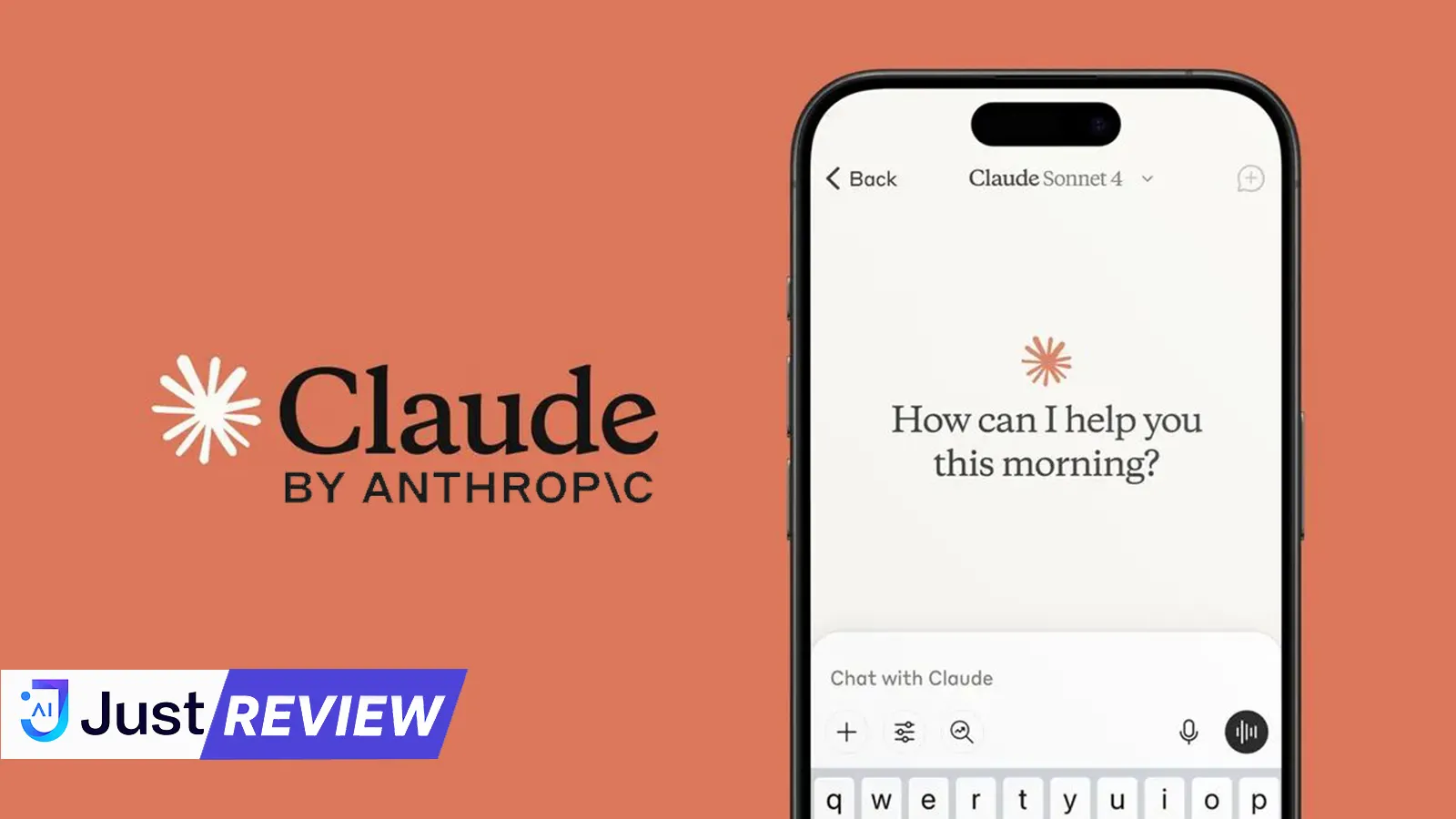
 Claude Review 2026: Brilliant AI, Brutal Billing
Reviewed by JustPrompt Editorial Team · Updated July 12, 2026
BestTrending
4.8/5
We tested Claude's models, Claude Code, Artifacts, and usage limits to see who gets real value at $20–$200/month — and who should pick ChatGPT instead.
- Best-in-class reasoning for complex problems
- Excellent for learning to code
- Seamless multi-device sync
- Transparent, self-correcting, no dark patterns
- Aggressive rate limits even on paid tiers
- Confusing, expensive token billing
- Guardrails block harmless requests
- Account bans with little recourse
Overview
Claude is the AI assistant built by Anthropic, the San Francisco lab founded in 2021 by former OpenAI researchers — including siblings Dario and Daniela Amodei — who left with a specific thesis: that frontier AI should be developed with safety engineered in from the start, not bolted on afterward. That origin story isn't just corporate lore; it shapes the product you actually use. Claude is trained with Anthropic's "Constitutional AI" approach, and the result is an assistant with a distinctive character — measured, careful about claims, more willing than most to say "I'm not sure" — that users tend to either deeply appreciate or find slightly restrained, depending on what they came for.
For its first two years, Claude was the connoisseur's choice: beloved by writers for prose that reads like a competent human rather than a press release, and by developers who quietly noticed its models topping coding benchmarks. What changed the trajectory was Claude Code, Anthropic's agentic coding tool, which became a genuine phenomenon in software engineering — the tool that, alongside Cursor, defined what AI-assisted development looks like in practice. Developer adoption pulled the whole platform upward: Anthropic's revenue multiplied at a pace rivaling any company in software history, driven heavily by professionals and businesses rather than casual consumers. That's the demographic tell worth knowing before you subscribe. Where ChatGPT is the mass-market default with close to a billion weekly users, Claude's audience skews professional: engineers, analysts, writers, researchers, and increasingly, companies deploying it for real work.
The modern product is much more than a chat window. The current model family — headlined by Claude Fable 5, with the Opus, Sonnet, and Haiku lines beneath it — powers a platform that includes Projects for organizing ongoing work with persistent files and instructions; Artifacts, a side-panel workspace where Claude builds interactive documents, code, and small apps you can run and iterate on live; web search with citations; a Research mode that autonomously compiles sourced reports; file analysis across huge documents thanks to industry-leading long-context handling; voice on mobile; memory features; and connectors that plug Claude into Drive, calendars, and company tools. On the agentic side, Claude Code lives in the terminal, IDEs, and a desktop app, while Claude Cowork extends the same delegate-a-task model to non-developers — pointing Claude at files and multi-step knowledge work and letting it grind through autonomously. Browser, Excel, and PowerPoint agents round out an increasingly complete "Claude does the work, you review it" story.
What Claude conspicuously doesn't do also defines it. There's no image generation and no video generation — a deliberate scope choice that keeps the product focused on text, code, analysis, and agentic work, and sends anyone wanting a one-stop multimedia suite elsewhere. The ecosystem of third-party plugins and consumer bells is thinner than OpenAI's, the mobile experience trails the desktop one in polish, and Anthropic ships consumer features at a more deliberate pace than its rival — usually arriving later, usually arriving more solid.
It helps to understand where claude.ai sits in Anthropic's wider business, because it explains the product's priorities. The consumer app is one storefront; the larger engine is the API, through which Claude's models power thousands of other products — coding tools, customer-service platforms, legal and financial software — and ship through Amazon's and Google's cloud platforms into enterprises that never touch claude.ai directly. Amazon and Google are also Anthropic's biggest investors, a structural fact that has kept the company capitalized for the compute arms race without a consumer advertising business. The consequence for you as a user: Anthropic optimizes for professional and enterprise workloads first, which is why the platform's energy visibly flows toward agents, coding, and work delegation rather than toward consumer delights like image generation or companion-style features — and why claude.ai feels less like a gadget and more like a work tool with every release.
Then there's the friction every honest review must lead with: usage limits. Claude's rate limits are stricter and less transparent than users want, expressed in rolling windows and multipliers rather than concrete message counts, and they've been the community's loudest complaint for two years. The low point came in 2025, when Anthropic introduced weekly caps on top of session limits — largely to curb a small number of accounts running Claude Code around the clock — and communicated it poorly enough to ignite real backlash from paying subscribers who suddenly feared metering. Limits have since been tuned and the pricing ladder gives heavy users somewhere to go, but the pattern matters: this is a product where the constraint you'll actually feel is capacity, not capability, and where Anthropic's compute scarcity is passed to users more visibly than competitors admit to doing.
Pricing & Plans
Claude's pricing mirrors its main rival almost dollar-for-dollar at the anchor points — the differences live in the usage limits, seat types, and what's bundled rather than in the headline numbers.
| Plan | Cena | Co zawiera |
|---|---|---|
| Free | $0 | Claude on web, desktop, and mobile with rolling usage limits; chat, file and image analysis, web search, and Artifacts — genuinely useful for exploration, deliberately tight for daily work |
| Pro | $20/mo ($17/mo billed annually) | Substantially higher limits, the full model lineup, Projects, Research mode, Claude Code and Cowork access, connectors, and priority during busy periods — the default tier for individual professionals |
| Max 5x | $100/mo | Pro features with roughly 5x the usage, higher output limits, and earliest access to new capabilities; aimed at daily heavy users and Claude Code regulars |
| Max 20x | $200/mo | The top individual tier with ~20x Pro usage for people running agentic workloads for hours a day — effectively infrastructure spend for AI-native professionals |
| Team | $25/seat/mo Standard ($20 annual); Premium seats ~$125/mo ($100 annual) with far higher limits | Shared workspace, admin controls, central billing, and no-training-by-default on business data; Premium seats exist mainly for developers who need Max-level capacity inside a team plan |
| Enterprise | Custom quote | SSO, compliance and security controls, expanded context windows, audit features, and dedicated support for large organizations |
Note the structural quirk: capability differences between tiers are small — you're overwhelmingly buying usage headroom, not features, so the right plan is a function of how many hours a day Claude works for you.
Key Features & Capabilities
- Frontier models with a distinctive character — Claude's models sit at or near the top of independent benchmarks for coding, reasoning, and agentic tasks, but the differentiator users cite most is qualitative: writing that sounds human, careful instruction-following, and fewer confidently wrong answers. For long-form writing, editing, and nuanced analysis, community consensus has treated Claude as the class leader for a while — a reputation our testing supports.
- Claude Code — The agentic coding tool that changed the company's trajectory: give it a task in the terminal, IDE, or desktop app and it plans, edits across a codebase, runs tests, and iterates to a working result. Bundled from the Pro tier up (with the API as a pay-per-token alternative), it's the strongest single argument for a subscription — and the reason the Max tiers exist, because serious daily use consumes Pro's allowance fast.
- Long-context document work — Claude handles enormous inputs — full codebases, hundred-page contracts, books — and, crucially, stays coherent deep into them. For professionals whose work is "here are 400 pages, find what matters," this remains one of the most reliable implementations in the industry.
- Artifacts — Claude's side-panel workspace where generated content — documents, code, interactive charts, small working web apps — lives as an editable, runnable object rather than a wall of chat text. You can iterate on the thing itself, share it, and even build little AI-powered tools without touching a development environment. It's quietly one of the best interface ideas in consumer AI.
- Projects and Research — Projects give recurring work persistent context: upload reference files, set standing instructions, and every conversation in that project starts informed. Research mode dispatches Claude to search, cross-reference, and compile cited reports over several minutes — comparable to rivals' deep-research features, with characteristically cautious sourcing.
- Cowork and the agent family — Cowork applies the Claude Code model to general knowledge work: point it at a folder and a goal — reorganize these files, build this spreadsheet from these PDFs, draft this deck — and review the results. With browser, Excel, and PowerPoint agents alongside, Claude's platform bet is unmistakably "delegation, not conversation," and it's further along that road for everyday office work than most users realize.
- Connectors and MCP — Anthropic created the Model Context Protocol, now an industry standard for wiring AI to external tools and data, and Claude uses it to connect to drives, calendars, project trackers, and company systems. The strategic upside of having invented the standard everyone adopted: Claude speaks natively to a fast-growing ecosystem of integrations.
- A safety-first design posture — More conservative defaults around risky content, visible honesty about uncertainty, and enterprise-grade data commitments (business tiers don't train on your data by default). Skeptics occasionally find the caution overtuned for edgy creative work; businesses and professionals mostly experience it as fewer embarrassing outputs to catch.
Verdict
Our verdict sorts cleanly by user type, because Claude is the most sharply targeted of the major AI assistants.
The strongest yes goes to three groups. Developers first: with Claude Code bundled at $20 and models that consistently lead coding evaluations, Claude Pro is arguably the best value in AI-assisted software development, and the Max tiers — expensive as they look — routinely cost less than the API tokens they'd replace for people running agents all day. Writers and editors second: for prose quality, tone control, and long-document revision, Claude remains the tool professionals in our orbit reach for first, and the gap is noticeable enough to justify choosing it on that basis alone. Knowledge workers third: the Projects-plus-Artifacts-plus-Cowork combination turns Claude into a genuine work environment rather than a chat toy, and teams get real governance at a per-seat price identical to individual Pro.
The clear no: anyone who wants one subscription for everything, especially media. No image generation, no video, a leaner voice experience, and a smaller consumer ecosystem mean that households, hobbyists, and creators who prize multimodal breadth will be happier with ChatGPT or Gemini, full stop. The same applies to anyone whose primary use is real-time information and shopping-style queries at high volume — Claude searches the web competently, but rivals with search-engine DNA lean harder into that use case. Bargain-focused users face the same conclusion from a different angle — Claude has no equivalent of an $8 tier, its free plan is tighter than its rival's, and Anthropic shows little interest in competing for casual usage it would lose money serving. And users who bristle at content caution should know Claude's guardrails are, by design, less negotiable than some alternatives'.
The honest middle concerns capacity and trust. Usage limits are the tax on everything good here: opaque enough to frustrate, tight enough that engaged Pro users will meet them, and historically communicated badly enough — the 2025 weekly-cap episode being the case study — that heavy users maintain a background anxiety about the meter. Anthropic has earned that scar tissue and has to keep earning it back with the steadier communication it has mostly shown since. Prospective subscribers should map their expected daily hours honestly against the tier multipliers, and treat the Max plans not as luxuries but as the real price of making Claude a full-time colleague.
For those subscribing, a short playbook maximizes the return. Set up Projects immediately for anything recurring — a codebase, a client, a book manuscript — with reference files and standing instructions, because Claude with context is a different product from Claude without it. Learn the model picker: routine tasks don't need the flagship, and choosing lighter models for light work stretches your usage allowance considerably. Developers should try Claude Code through the subscription before assuming they need API billing — the flat rate is usually the better deal below extreme usage, and the meter anxiety runs the other way above it. Review the privacy settings once, deliberately: consumer plans include controls over whether conversations improve the models, and that choice should be yours rather than a default you never saw. And if you're evaluating against ChatGPT, run your actual work through both free tiers for a week rather than reading comparisons — the two products have diverged enough in character that the right answer is personal, and discovering it costs nothing.
Zooming out to reputation: among professional users, developers especially, Claude's standing is about as strong as it gets in this industry — high marks on review platforms, dominant mindshare in AI coding discussions, and enterprise growth that speaks to how it performs under real workloads. The recurring knocks — limits, missing multimodality, slower consumer feature cadence — are all true and all priced into who should buy it. Our conclusion mirrors the market's revealed preference: Claude is the professional's AI assistant, the one you pick when the work is text, code, analysis, or delegation, and when output quality matters more than feature count. Pick it for that, pair it with a specialist tool if you need images or video, and size the tier to your actual hours — that combination is, for working professionals in 2026, very hard to beat.
Similar Tools
BestTrending
4.7/5
The leading AI assistant used for writing, coding, research and everyday tasks.
Trending
4.0/5
A rapidly growing AI model recognized for strong reasoning and coding capabilities.
BestTrending
4.7/5
Google's multimodal AI assistant designed for productivity, research and creative tasks.
Trending
4.3/5
xAI conversational assistant focused on real-time information and social data.
3.9/5
Meta's conversational AI assistant integrated with social platforms and messaging apps.
Trending
4.6/5
AI-powered search engine combining real-time data with conversational answers.
People Also Ask
What is Claude?
Claude is an AI chatbot and reasoning assistant built by Anthropic, available on iPhone, iPad, Android, and desktop. Based on our testing, it stands out as one of the strongest reasoning engines currently available, handling complex, multi-step problems with more honesty and self-correction than many competitors. It's especially useful for coding education, technical explanations, creative writing, and everyday research, offering different models like Sonnet for depth and Haiku for quick, low-friction answers. Claude also supports prompt engineering workflows well, since it responds predictably to carefully structured instructions and clarifies its own uncertainty rather than guessing. Sync across devices works seamlessly, so a conversation started on desktop can continue on mobile without losing context. That said, Claude isn't just a casual chat tool — in our experience it shines brightest for technical, analytical, and learning-focused tasks rather than lightweight social or marketing use cases.
Is Claude free?
Claude offers a free tier, but in our testing the usage caps were tight enough that we regularly ran out of allotted questions within a single session. If you're doing light, occasional tasks, the free version can work, but anything involving sustained coding help or long research threads will likely hit limits quickly. Upgrading to Claude Pro doesn't fully solve this either — we hit unexplained usage limits before expecting to, and the token-based add-on billing felt murky, with overage costs sometimes far higher than anticipated for what should have been short sessions. So while Claude is technically accessible for free, we wouldn't call it a free ai document processing or heavy-workload solution unless you're prepared to pay for Pro and still monitor usage carefully, since predictable billing is not this product's strong suit.
Is Claude better than ChatGPT?
In our head-to-head testing, Claude's underlying model consistently produced sharper, more honest answers than ChatGPT on complex, multi-step problems. It was more willing to admit uncertainty or correct itself mid-conversation, which built more trust over repeated use, and we found it especially strong for learning to code — explaining concepts more clearly and patiently than most alternatives we tested. However, ChatGPT's product experience around billing transparency and account stability felt more consistent in our use. So on raw intelligence and reasoning quality, Claude wins in our assessment. But if you need predictable costs, guaranteed uptime, or worry-free account management for business-critical work, ChatGPT's ecosystem may currently feel more dependable. It really comes down to whether you're prioritizing model intelligence or product reliability.
Does Claude have usage limits?
Yes, and this was one of our biggest frustrations during testing. The free tier's usage caps are tight — we burned through our allotted questions in a single session more than once. Upgrading to Claude Pro should theoretically fix this, but it didn't work the way we expected: we hit unexplained limits well before we felt we'd earned them, based on typical usage patterns. On top of that, the token-based add-on billing behind Pro felt murky, with quick sessions that should have cost a few dollars in overage ending up costing significantly more, without a clear breakdown of why. If you're relying on Claude for sustained, high-volume work — long coding sessions, extensive research, or heavy daily use — budget for surprises and keep an eye on your usage dashboard, because the limits and costs aren't always intuitive or transparent.
Is Claude worth it?
It depends on what you need it for. If you want the smartest available AI for coding education, technical reasoning, or long-form thinking, and you're comfortable staying within a free or lightly-paid tier, Claude is genuinely hard to beat — we'd recommend it over most competitors on intelligence alone. But if you're planning to lean heavily on Pro, expect predictable billing, or need guaranteed uptime for professional, business-critical workflows, go in with realistic expectations. We ran into inconsistent stability, including chat history vanishing after an app update and voice input failures on Android, plus anecdotal reports of accounts being suspended without a working appeal path. So Claude is absolutely worth using for deep reasoning tasks — just keep a backup plan and don't put all your critical work on a single account.
Does Claude have guardrails that block requests?
Yes, and this was one of the more jarring issues we encountered. During testing, legitimate, benign requests — including creative writing feedback and casual brainstorming — occasionally got flagged and refused using vague "safety" language that had nothing to do with the actual content being discussed. It's an unsettling experience when a tool this capable suddenly acts like it doesn't trust a completely reasonable prompt. This inconsistency in guardrail behavior means you may need to rephrase or restructure requests that get unexpectedly blocked, even when there's nothing objectionable about them. It's worth noting for anyone doing sensitive creative work, edgy brainstorming, or content that touches gray-area topics — Claude's refusals aren't always predictable, and there isn't a transparent explanation offered when they happen.
What are the best Claude alternatives?
If Claude's billing unpredictability, guardrail refusals, or account stability issues are dealbreakers, it's worth comparing alternatives based on what you value most. For raw reasoning and coding help with more predictable pricing and product polish, ChatGPT remains the most direct comparison we tested against. If your priority shifts toward lighter, more casual use cases — like content creation, social media ai tools, or quick brainstorming without strict usage caps — other AI assistants built specifically for those workflows may serve you better than a general-purpose reasoning model. The right alternative really depends on your use case: for deep technical work, few tools match Claude's intelligence, but for high-volume, budget-predictable, or business-critical use, it's worth testing a couple of options before committing fully to one platform.