
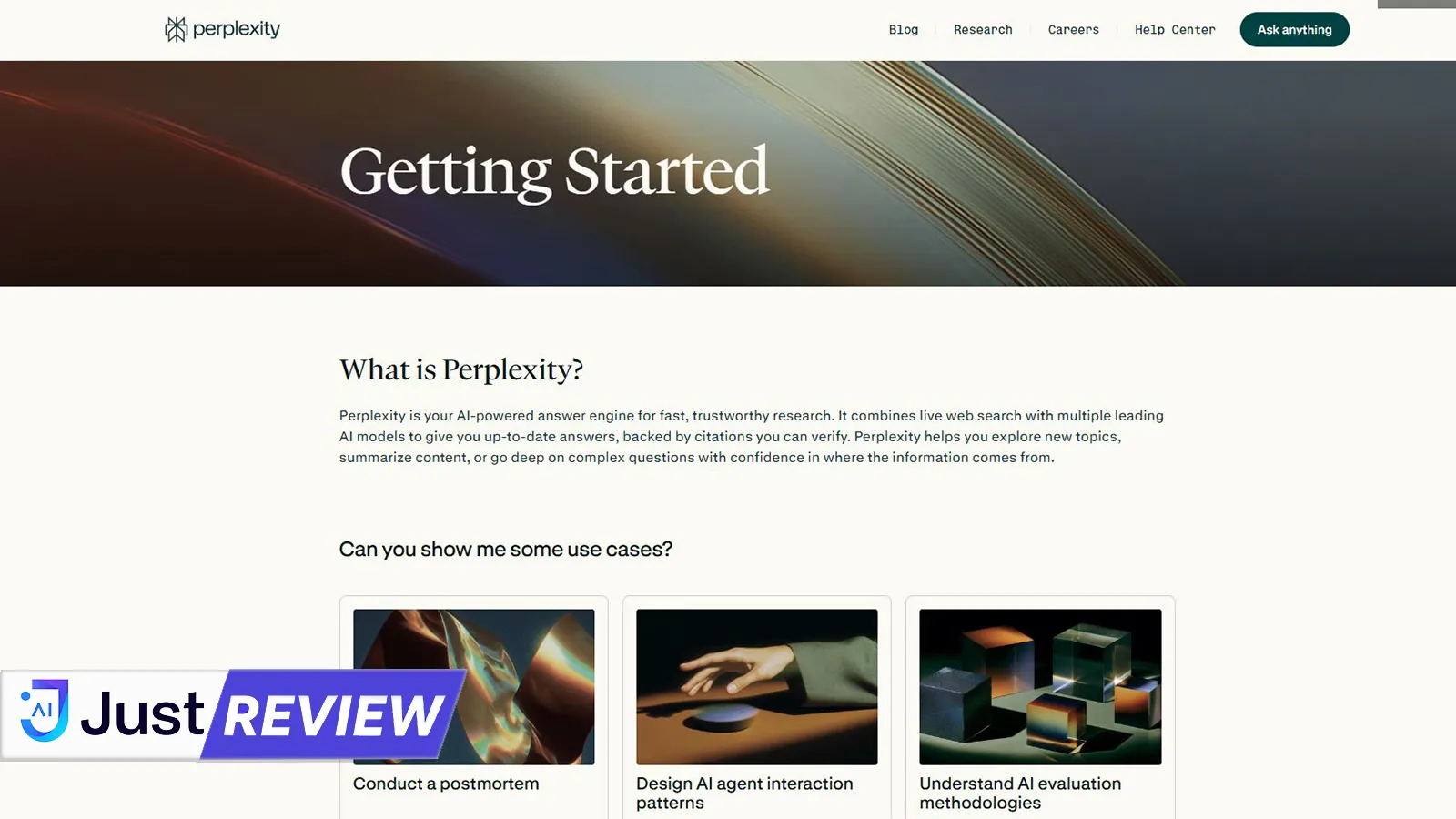
 Perplexity Review: Brilliant Answers, Frustrating Business Model
Reviewed by JustPrompt Editorial Team · Updated July 13, 2026
Trending
4.6/5
Perplexity nails cited, fast AI search — but our testing found a subscription and billing experience that undercuts the product's genuine brilliance.
- Fast answers with visible source citations
- Great for research summaries and fact-finding
- Clean, readable formatting for complex topics
- Handy photo identification feature
- Occasional hallucinated facts and broken citation links
- Aggressive paywall and confusing subscription billing
- Inconsistent image generation, no offline mode
Overview
Perplexity set out to replace the search engine, and whatever else you conclude about it, that ambition stopped sounding absurd. Founded in 2022 by Aravind Srinivas and a small team of AI researchers, the product's founding insight was almost embarrassingly simple: instead of ten blue links, answer the question — in prose, with numbered citations pinned to real sources you can check. That single interaction pattern proved so obviously better for a huge class of queries that the giants copied it outright; Google's AI answers and every chatbot's web-search mode are, functionally, the industry conceding Perplexity's point. The company rode that validation to hundreds of millions of monthly queries, a valuation in the tens of billions, and a reputation as the most aggressive challenger brand in AI — famous in equal parts for shipping relentlessly and for pursuing publicity with stunts like its multi-billion-dollar unsolicited bid for Google's Chrome browser.
The product in 2026 is an answer engine grown into a research platform. The free tier delivers unlimited cited searches with a daily taste of the heavier "Pro Search" mode, and it's genuinely usable — for quick factual questions with receipts, many people need nothing more. Pro unlocks the machinery: unlimited Pro Searches that decompose questions and synthesize across sources; a daily allotment of Deep Research, which autonomously reads dozens of sources and returns structured, cited reports in minutes; and — Perplexity's quietly killer feature — your choice of frontier models from OpenAI, Anthropic, Google, and others as the reasoning engine behind those searches, making a single $20 subscription a sampler of the industry's best brains pointed at the live web. Around the core sit Spaces (project workspaces with uploaded files and custom instructions), file analysis, image generation, finance dashboards with real-time market data, shopping with agentic checkout experiments, and a Discover feed. Labs, on the higher tier, spins prompts into spreadsheets, dashboards, and mini-apps; Perplexity Computer, the newest Max-tier flagship, orchestrates a fleet of models and hundreds of app connectors into an autonomous agent for multi-step work.
Then there's Comet, the bet that the browser itself is the next interface. Launched mid-2025 as an eye-wateringly exclusive $200-tier perk and freed for everyone by 2026, Comet is a Chromium browser with Perplexity woven through it: an assistant that reads the page you're on, summarizes, compares tabs, fills forms, and executes tasks by driving the web like a hand on your mouse. Used for research, it's legitimately the most futuristic mainstream browsing experience available, and its free release was a land-grab aimed straight at Chrome's complacency. It also carries the new category's growing pains: security researchers demonstrated that agentic browsers can be hijacked through malicious page content — Comet was tricked into a phishing flow in minutes in one published test — and prompt injection remains the whole category's unsolved disease. A browser that acts on your behalf is a browser that can be talked into acting badly; early adopters should grant it autonomy the way they'd grant it to a gifted, gullible intern.
The business model behind all this clarified itself in 2026, and the clarification favors users. After flirting with advertising, Perplexity abandoned the experiment outright and committed to subscriptions as the whole revenue story — a genuine structural difference from search incumbents whose answers must ultimately serve advertisers, and a claim to alignment ("we make money when the answers are worth paying for") that the company now has to live up to rather than merely assert. Distribution runs the challenger playbook at full speed: free Pro subscriptions bundled through telecom carriers and payment platforms across huge markets, aggressive student pricing, the browser given away, the API sold to developers — every channel optimized to make Perplexity a habit before Google finishes retrofitting itself. Whether that converts into durable economics against rivals who can subsidize forever is the open bet investors priced in the tens of billions; for subscribers, the near-term consequence is simpler and pleasant — a company this hungry keeps shipping, keeps discounting, and can't afford to let the product coast.
The company's original sin, by its critics' account, is how the answers get made. Publishers have accused Perplexity of scraping content against their wishes — including reports of crawlers ignoring blocking standards — and of laundering journalism into summaries that capture the value while starving the source of the click. The receipts are not trivial: plagiarism controversies documented by major outlets, cease-and-desists, and a docket of lawsuits from news organizations, reference publishers, and international media groups that together form the sharpest legal challenge any answer engine faces. Perplexity's response — a revenue-sharing publisher program, the Comet Plus subscription that pays partner outlets, prominent citations by design — is more constructive than most of the industry has offered, and sincere people disagree about whether it's fair payment or fig leaf. Users don't have to adjudicate that to notice the practical corollary: the answers are only as good as the sourcing, citation errors and confident misreadings do occur, and the discipline of clicking the little numbers — the feature that makes Perplexity checkable — is one the tool teaches and some users forget.
Pricing & Plans
Perplexity's lineup spans a genuinely useful free tier, two consumer subscriptions, education and enterprise seats, a now-free browser with a small add-on, and a developer API — verified for July 2026, with the note that this company reshuffles SKUs faster than almost anyone, so confirm before budgeting.
| Plan | Cena | Co zawiera |
|---|---|---|
| Free | $0 | Unlimited basic searches with citations plus ~5 Pro Searches daily, standard models, the Discover feed — and full use of the free Comet browser; honestly sufficient for casual sourced Q&A |
| Pro | $20/mo ($200/yr ≈ $16.67/mo) | Unlimited Pro Search, ~20 Deep Research queries/day, choice of frontier models (GPT, Claude, Gemini and more), Spaces with file uploads, image generation, Comet Plus included — the tier most serious users mean by "Perplexity" |
| Education Pro | $10/mo (verified students) | Pro-level features at half price — the obvious pick for anyone with a student email |
| Max | $200/mo ($2,000/yr) | Top-model access at the highest limits, unlimited Labs (reports, spreadsheets, mini-apps), Perplexity Computer with a 10,000-credit monthly allowance for autonomous multi-model workflows, premium video generation, priority support |
| Enterprise | Pro $40/seat/mo; Max ~$325/seat/mo | Consumer features plus SSO, admin controls, no-training data guarantees, org file repositories, and (Max) heavy agentic and research capacity with audit and retention controls |
| Comet / Comet Plus / API | Browser free; Comet Plus $5/mo (bundled into Pro/Max); Sonar API from ~$1/M tokens plus request fees | The browser costs nothing on all platforms; the add-on funds partner publishers' content; the API sells the search-grounded models to developers on separate metering |
Two fine-print notes: Perplexity replaced fixed daily caps with weekly usage limits on Pro, so sustained heavy bursts can hit ceilings the marketing doesn't emphasize — and Max's Computer credits have no published top-up pricing, which heavy agentic users should treat as a planning risk.
Key Features & Capabilities
- Cited answers as the default — Every response arrives with numbered, clickable sources — the product's founding feature and still its character: answers built to be verified, not believed. The citations are also the honest caveat's home: sourcing quality varies, and checking remains the user's job.
- Deep Research — Ask a hard question and it autonomously searches, reads dozens of sources, and returns a structured cited report in minutes. Among the best implementations of the deep-research pattern anywhere, and on Pro it's a daily-driver allowance rather than a rationed treat.
- Multi-model choice — Pick the frontier model that reasons over your searches — GPT, Claude, Gemini, Perplexity's own Sonar — inside one subscription. For $20, it's the cheapest legitimate way to run the industry's best models against the live web, and a hedge against any one lab's off week.
- Comet, the AI browser — Free for everyone: an assistant that reads your tabs, summarizes, compares, fills forms, and executes web tasks agentically. The most convincing preview of post-Chrome browsing shipping today — to be used with the security humility the prompt-injection era demands.
- Spaces — Project workspaces with uploaded files, custom instructions, and shared threads — turning scattered research into organized, resumable investigations. Underused by casual subscribers, load-bearing for professionals.
- Labs and Perplexity Computer (Max) — Labs converts prompts into spreadsheets, dashboards, reports, and small web apps; Computer orchestrates many models and hundreds of app connectors into autonomous multi-step workflows on a credit meter. Impressive, genuinely useful for structured deliverables, and priced for people whose time bills accordingly.
- Finance and vertical surfaces — Real-time market dashboards, earnings summaries with sources, crypto data, sports, shopping with agentic checkout experiments. The finance surface in particular has earned a following as a free Bloomberg-lite for retail research — with the standing reminder that cited is not the same as infallible.
- Sonar API — Perplexity's search-grounded models for developers, priced per token plus request fees — the answer-engine-as-a-service layer powering search features in other products.
Verdict
Our verdict distinguishes what Perplexity is best at from what it's merely good at, because the subscription question turns on that line.
Best at: research with receipts. For journalists, analysts, students, lawyers-adjacent professionals, consultants, and anyone whose output must survive the question "source?", Perplexity Pro is arguably the highest-leverage $20 in the AI market — unlimited decomposed search, a daily Deep Research budget that replaces hours of tab-juggling, and frontier-model choice that quietly obsoletes single-lab loyalty for web-grounded work. The free tier is the category's most honest: genuinely useful indefinitely, not a nagging trial, and now paired with a free agentic browser that costs rivals real money to match. Students at $10 shouldn't deliberate long. And teams whose work is structured research — market intelligence, diligence, policy analysis — get real governance value at Enterprise Pro's $40 seats.
Merely good at: everything a general assistant does. For creative writing, long coding sessions, brainstorming, or emotional-intelligence work, the frontier assistants themselves remain stronger homes — Perplexity wraps their models but optimizes the wrapper for search, and users who want a thinking partner more than an answer engine will feel the tuning. Max at $200 is a professional tool with a professional's break-even: unlimited Labs and the Computer agent can genuinely pay for themselves in analyst-hours, but most Pro users sampling the Computer credits included in their tier will correctly conclude they're not the customer yet — and the unpublished top-up pricing on Computer credits is the kind of open question $200/month buyers deserve answered.
Eyes-open territory, in three parts. Accuracy: cited is checkable, not correct — the tool's confident synthesis occasionally outruns its sources, misattributes, or leans on weak pages ranked high, and professional users should treat it as a brilliant first-pass researcher whose footnotes get audited before anything ships. Security: Comet's agentic powers inherit the prompt-injection vulnerabilities of the whole category; keep autonomous actions away from logged-in financial and identity contexts until this class of attack is convincingly solved, and treat "the browser did something I didn't ask" reports as the category's weather, not lightning. Ethics: the publisher conflict is unresolved and material — a docket of serious lawsuits, accusations of crawler misbehavior the company disputes, and a revenue-sharing response whose adequacy is genuinely contested. Subscribers aren't obligated to settle that argument, but readers of a tools catalog deserve to know the product's supply chain is in court, and that the outcome could reshape what the answers are allowed to contain.
A short playbook extracts most of Pro's value in the first week. Match models to tasks deliberately — reasoning-heavy syntheses to the strongest model, quick lookups to the fast ones — rather than leaving the picker on default; the choice is the feature you're paying for. Build a Space for anything you'll research more than twice, load the reference files once, and let context accumulate instead of re-explaining. Spend Deep Research on questions worth ten sources, not on what a Pro Search answers in one — the daily allowance feels infinite until the day it doesn't. Develop the two-click verification habit: before any claim leaves your draft, open its citation and confirm the source says what the summary says — the divergences are rare enough to trust the tool and common enough to check it. And in Comet, keep the assistant in read-and-summarize mode for sensitive sessions, saving agentic actions for low-stakes tasks until the browser category earns more trust than it currently deserves.
Who should skip it: users fully served by their assistant's built-in search (the gap has narrowed for casual queries), creative-first workers, teams needing agentic browsing inside hardened security perimeters, and anyone who wants one subscription for everything — Perplexity complements a frontier assistant more than it replaces one, which at $20 alongside another $20 is a real budget line to justify.
Weighing it: the category-defining answer experience, the market's best research value at Pro, multi-model pragmatism, a free tier and free browser of unusual generosity, and shipping velocity nobody matches — against accuracy that demands verification discipline, a browser inheriting its category's security disease, a $200 tier with unfinished economics, and the industry's most consequential unresolved fight with the people who make the content the answers are made of. That lands Perplexity high with sharp edges: the researcher's tool of the era, recommended with the same habit it should have taught you by now — check the sources.
Similar Tools
BestTrending
4.7/5
The leading AI assistant used for writing, coding, research and everyday tasks.
BestTrending
4.8/5
Advanced AI assistant known for long-form reasoning and structured outputs.
BestTrending
4.7/5
Google's multimodal AI assistant designed for productivity, research and creative tasks.
Trending
4.3/5
xAI conversational assistant focused on real-time information and social data.
3.7/5
An AI search platform that combines traditional search with conversational AI tools.
4.2/5
Build and manage custom AI workflows using prompts and models.
People Also Ask
What is Perplexity?
Perplexity is an AI-powered "answer engine" built by Perplexity AI that takes natural-language questions, searches the live web, and returns a synthesized answer with inline citations pointing back to the exact source for each claim. Rather than relying on a single proprietary model, it routes queries to whichever model — GPT, Claude, Gemini, or its own in-house Sonar models — is best suited to the task, and lets paid subscribers pick a model manually. Beyond the core search box, Perplexity has expanded into Spaces for organizing research threads, Labs for generating dashboards and simple web apps, and Comet, its own Chromium-based AI browser with agentic browsing built into the address bar. It's best described as a research assistant that shows its work, rather than a typical chatbot, which is why many users have replaced their default search engine with it entirely.
Is Perplexity free?
Yes, Perplexity has a genuinely usable free tier — it's not a crippled trial. Free users get unlimited basic searches with citations, a small daily cap on Pro Search and Deep Research queries, access to Focus modes (Web, Academic, Reddit, YouTube, News, Wolfram Alpha), and even free access to the Comet browser. If you want unlimited Pro Search, a daily Deep Research allowance, full model selection across GPT, Claude Opus, and Gemini, image/video generation, file uploads, Spaces, and Labs, you'll need the Pro plan at $20/month (or $200/year), which price-matches ChatGPT Plus and Claude Pro. There's also an Education Pro tier at $10/month for verified students, plus Max and Enterprise tiers for heavier or team usage. Our recommendation is to start free and only upgrade once you actually hit its daily limits.
Is Perplexity worth it?
For research, fact-checking, and staying current on fast-moving topics, Perplexity is one of the strongest AI tools on the market — the citation-first approach solves a real trust problem with AI chatbots, and the multi-model flexibility means you're rarely stuck with an underpowered model. The free Comet browser, with genuine agentic capabilities like summarizing pages and comparing prices across tabs, pushes it from "a good search chatbot" into a platform you could build a workflow around. Where it stumbles is on the business side: billing and cancellation friction — surprise charges, buried cancel buttons, and paywalled basics like photo uploads — shows up often enough in user feedback to be a real concern, and hallucinations remain possible even with citations. Our take: it's worth trying via the free tier first, and worth paying for once you've hit its limits, but keep a close eye on your billing statement if you go Pro.
Is Perplexity better than ChatGPT for research?
For research specifically, Perplexity has a meaningful edge over a plain ChatGPT session: every answer comes with inline citations linking back to the original source, so you can verify claims rather than trusting the model's word. Perplexity also isn't locked to one foundation model — Pro and Max users can route queries to GPT, Claude, Gemini, or Perplexity's own Sonar models, and even run a query across multiple frontier models at once with Max's Model Council. ChatGPT still tends to have an edge for creative writing and coding polish, and at $20/month the two are price-matched, so the decision often comes down to whether you value citation-backed research over general-purpose chat and content generation. Users specifically call out Perplexity as feeling better than a traditional chatbot for breaking down a research topic or fact-checking a claim, which is the core reason many switch to it as their default research tool.
Does Perplexity have its own browser?
Yes — Perplexity built Comet, its own Chromium-based AI browser, and it's now free for everyone rather than a paid-only feature. Comet adds an AI sidebar directly into the browsing experience that can summarize the page you're on, compare prices across open tabs, and in some cases complete multi-step tasks like form-filling autonomously (agentic browsing). It's a notable step beyond a typical search chatbot, since it bakes AI assistance directly into the address bar instead of requiring you to copy and paste content into a separate app. That said, the review notes an important asterisk: "it works" and "it works reliably" are two different claims with Comet, so agentic tasks are genuinely useful but not always consistent — treat it as a promising but still-maturing feature rather than a fully dependable automation layer.
Does Perplexity ever get facts wrong or hallucinate?
Yes, Perplexity can still hallucinate a fact or cite a source that doesn't actually check out — this shows up as a recurring, if secondary, complaint in user feedback, alongside more common gripes about billing. That said, its citation-first design makes hallucinations easier to catch than with a plain chatbot, since every claim links to a specific source you can click through and verify yourself. This doesn't make Perplexity unique in having this problem — it's a limitation shared by essentially every large language model — but the built-in citations meaningfully reduce the risk of blindly trusting a fabricated answer. If accuracy matters for a given task, the review's advice is to actually click through the citations rather than taking the synthesized answer at face value, especially for Deep Research reports pulling from dozens of sources.
What are the different Perplexity pricing plans?
Perplexity now offers a six-tier pricing lineup: Free ($0) with unlimited basic search and capped Pro Search/Deep Research; Education Pro ($10/month) for verified students and educators; Pro ($20/month or $200/year) with unlimited Pro Search, full model selection, image/video generation, Spaces, Labs, and Comet; Max ($200/month or $2,000/year) adding Model Council, Perplexity Computer, and higher research limits; Enterprise Pro ($40/seat/month) with SSO, admin controls, and a no-training-on-data guarantee; and Enterprise Max ($325/seat/month) with unlimited-scale Deep Research and dedicated account management. For most individual users, the jump from Pro to Max only makes sense if you're genuinely leaning on Deep Research and Labs at scale — otherwise the $200/month tier feels steep. The enterprise ladder is aimed squarely at teams needing governance controls rather than casual users.