
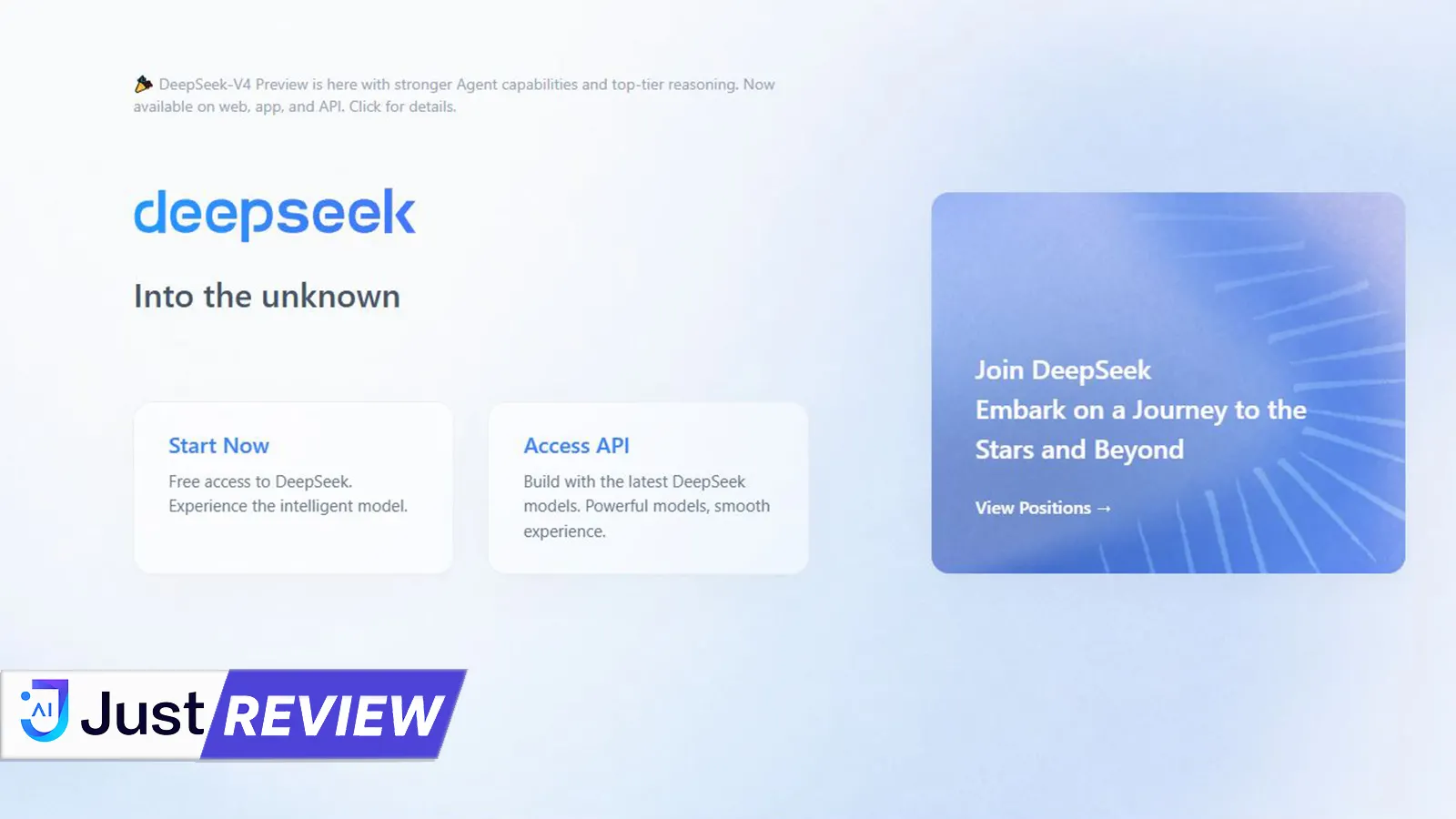
 DeepSeek Review 2026: Still the Best Free AI, Flaws and All
Reviewed by JustPrompt Editorial Team · Updated July 13, 2026
Trending
4.0/5
We tested DeepSeek's free app, dirt-cheap API, and open models — and weighed the China data question — to see exactly who should use it, and for what.
- Genuinely free with no paywall pressure
- Strong coding and technical reasoning
- Excellent image and vision understanding
- Fast, natural conversational tone
- Clean interface with solid dark mode
- New message and regeneration limits frustrate regular users
- Frequent server 'busy' errors mid-session
- Unpredictable switch to Chinese despite English settings
- Occasional crashes and reasoning errors
Overview
DeepSeek is the AI lab that broke the industry's pricing logic — and briefly, the stock market. Founded in 2023 in Hangzhou by Liang Wenfeng and bankrolled by his quantitative hedge fund High-Flyer, DeepSeek spent its first year as an obscure Chinese research outfit publishing unusually good open models. Then, in January 2025, it released the R1 reasoning model: performance in the neighborhood of OpenAI's best reasoning systems, trained for a fraction of the assumed cost, released with open weights anyone could download, and served through an API priced at pennies where competitors charged dollars. The reaction was seismic — a global app-store number one, a trillion-dollar tech selloff as investors panicked about AI economics, and a permanent shift in what the market considers a fair price for intelligence. Whatever you think of DeepSeek, every cheap AI API you use today is cheaper partly because this company exists.
How a hedge fund's side project undercut the richest labs on Earth is worth a paragraph, because the answer isn't just cheap labor or subsidy — it's engineering under constraint. Facing US export controls that restrict China's access to top AI chips, DeepSeek optimized ferociously: sparse mixture-of-experts architectures that activate only a fraction of the model per token, novel attention and memory-compression techniques, low-precision training methods, and infrastructure tricks published openly in papers that Western labs read closely. The result was training and serving costs low enough to make near-frontier AI a loss-leader a hedge fund could afford as a research flex. Skeptics note the famous headline training figures excluded plenty of real costs, and OpenAI publicly alleged that DeepSeek's models benefited from distilling outputs of its own — an accusation carrying its own irony, given the provenance of the data most frontier models trained on, and one that never dented adoption. However the accounting settles, the efficiency innovations are real, independently replicated, and now part of how everyone builds models — arguably DeepSeek's most durable contribution.
A year and a half later, DeepSeek is no longer a shock — it's a fixture. The model lineup has advanced through successive V3 generations to the current V4 family, spanning a fast, cheap workhorse and a heavier flagship, alongside the R1 reasoning line, with performance that keeps DeepSeek within striking distance of the Western frontier on coding, math, and reasoning benchmarks — usually a step behind the very best from OpenAI, Anthropic, and Google, and usually at one-tenth to one-thirtieth of their price. The consumer product at chat.deepseek.com and in the mobile apps remains almost provocatively simple: the current models, file uploads, web search, a code-preview feature — and no paid tier at all. There is no DeepSeek Plus, no Pro subscription, no upsell. The entire consumer product is free, throttled only by fair-use limits that surface as "server busy" messages at peak times.
The business model, such as it is, lives in the API — and it's the cheapest serious AI API in the world. Pay-as-you-go token pricing starts around $0.14 per million input tokens for the fast model, automatic prompt caching slashes repeated-context costs by up to ~90%, off-peak windows have historically discounted rates by 50–75%, and new accounts get millions of free tokens to prototype with. For developers, the economics are less a discount than a different category: workloads that are unjustifiable on Western APIs become rounding errors here. Layer on the open-weights releases — downloadable, self-hostable, modifiable, commercially usable — and DeepSeek has become the default substrate for a huge share of the world's budget AI products, academic research, and on-premise deployments.
Now the other half of the ledger, because no honest review of DeepSeek can be written without it. DeepSeek is a Chinese company, its hosted services store user data on servers in China subject to Chinese law, and its models — on the hosted service — visibly refuse or deflect politically sensitive topics: questions about Tiananmen Square, Taiwan's status, or criticism of the Chinese government meet template evasions. Multiple governments have banned the app from official devices, and regulators in several countries have investigated or restricted it over data-protection concerns. Early in its fame, a security lapse exposed an unsecured internal database containing chat histories — patched quickly, but not confidence-inspiring. Independent red-team testing has also repeatedly found DeepSeek's safety guardrails easier to bypass than those of major Western rivals. None of this is hidden; all of it defines who should use which version of DeepSeek, and how. The crucial nuance — the one that makes DeepSeek genuinely interesting rather than simply compromised — is that the open weights offer an exit: run the models yourself, or through a Western hosting provider, and the data-sovereignty problem largely dissolves, though the models' trained-in political alignments travel with the weights wherever they go.
Pricing & Plans
DeepSeek has no subscriptions at all — the consumer app is entirely free, and developers pay per token with no monthly fee, which makes its "pricing table" look unlike anything else in this catalog.
| Plan | Cena | Co zawiera |
|---|---|---|
| Chat app (web + mobile) | $0 | Full access to the current model lineup, including reasoning mode, file uploads, web search, and code preview; no paid tier exists — limits are fair-use throttling at peak hours |
| API — fast model (V4-Flash class) | ~$0.14/M input, ~$0.28/M output tokens | The budget workhorse for high-volume production tasks, with a large context window; cache hits cut input costs by up to ~90–98% |
| API — flagship (V4-Pro class) | ~$0.44/M input, ~$0.87/M output tokens | The strongest general model, priced after a permanent deep cut — still several times cheaper than Western flagship APIs |
| API — R1 reasoning | ~$0.55/M input, ~$2.19/M output tokens | Chain-of-thought reasoning for math, planning, and hard debugging; generates verbose reasoning tokens, so real per-query costs run higher than the rate suggests, yet remain ~95% below Western reasoning models |
| New developer grant | Free | Roughly 5 million tokens for new API accounts, valid ~30 days — enough to prototype seriously at zero cost |
| Self-hosted / third-party | Free weights + your compute | Open-weight releases can be run on your own hardware or via Western clouds and aggregators, trading DeepSeek's rock-bottom hosted prices for data control |
Two practical notes: prices have been cut repeatedly and off-peak discount windows have historically applied automatically, so verify current rates in the official API docs — and structure prompts with static content first, because caching is the single biggest lever on your bill.
Key Features & Capabilities
- Frontier-adjacent models at commodity prices — The V4 family delivers coding, reasoning, and general performance close enough to the Western frontier that for a large majority of real tasks the difference is imperceptible, at prices lower by an order of magnitude or more. This price-performance ratio, not any single feature, is the product.
- R1 reasoning models — DeepSeek's chain-of-thought line thinks visibly before answering — and showing its full reasoning trace was itself an influential design choice competitors partially adopted. For math, algorithmic problems, and multi-step analysis, R1-class models remain among the best value in existence for quantitative work.
- Open weights under permissive licensing — Major models ship as downloadable weights usable commercially, modifiable, and distillable. This single decision spawned an ecosystem: local deployments on consumer hardware, fine-tuned industry variants, academic research that closed labs can't support, and hosting by every major cloud — the option Western frontier labs mostly won't give you.
- Aggressive prompt caching — Repeated context (system prompts, documents, codebases) is cached automatically and billed at a small fraction of normal input rates. For agents and document-heavy applications, effective costs drop far below even the headline prices, which is how production workloads on DeepSeek end up costing single-digit dollars where competitors bill hundreds.
- A genuinely free consumer app — Web search, file analysis, reasoning mode, code previews — capabilities that cost $20/month elsewhere — for nothing, indefinitely. The trade is peak-hour congestion, a sparser feature set (no image generation, no voice mode, no ecosystem of plugins), and the data-jurisdiction question covered throughout this review.
- OpenAI-compatible API — The API mimics OpenAI's format, so switching an existing application to DeepSeek is often a two-line change of base URL and key. Low switching costs cut both ways, and DeepSeek uses them as a weapon: trying it inside your existing stack takes minutes.
- Coding strength — DeepSeek's models have been particularly strong at code generation and debugging relative to their price since the company's earliest releases, and they power a long tail of budget coding assistants and agents. For cost-sensitive development tooling, they're the default engine of the category.
Verdict
Our verdict on DeepSeek requires answering two different questions — is it good, and is it appropriate — because the answers diverge more than for any other tool in this catalog.
On capability per dollar, DeepSeek has no equal. Developers and startups building AI features on a budget should treat it as the obvious first stop: the API's economics make entire product categories viable that Western pricing forecloses, the OpenAI-compatible interface makes evaluation nearly free, and caching plus off-peak scheduling can push costs toward negligible. Students, hobbyists, and price-sensitive users anywhere in the world get a legitimately strong assistant for nothing. Researchers and tinkerers get what the closed labs won't offer: weights they can dissect, fine-tune, and run on their own metal. And organizations that want strong models fully inside their own infrastructure — no data leaving the building — will find DeepSeek's open releases among the best self-hostable options in existence. If your use case is code, math, analysis, drafting, or high-volume text processing, and your data is not sensitive or your deployment is self-controlled, DeepSeek is an easy, even exciting recommendation.
The "appropriate" question cuts the other way. If you use DeepSeek's hosted app or API, your data goes to servers in China, under a legal regime that can compel access to it — which is precisely why government agencies across multiple countries have banned it from official devices, and why we'd extend the same logic to anyone handling client confidences, trade secrets, health information, or anything a regulator cares about. European businesses face unresolved GDPR exposure on top. This isn't paranoia to be argued away by the low prices; it's the actual cost structure of the product — you're paying with jurisdiction instead of dollars. The censorship question is related but distinct: the hosted service's refusal to engage with topics sensitive to Beijing makes it unsuitable as a general information tool for politics, history, or current events, and the trained-in alignments persist to varying degrees even in self-hosted weights. Journalists, educators, and anyone who needs an assistant that answers hard questions about China honestly should use something else — or at minimum, know exactly where this tool goes silent. Add the weaker safety guardrails, a consumer app that trails Western rivals in features and polish, no image or voice capabilities to speak of, and a young company whose security practices had at least one public failure, and the picture sharpens: DeepSeek is a phenomenal engine and a questionable custodian.
The synthesis we'd offer JustPrompt readers: use DeepSeek where its trade-offs don't touch you. Non-sensitive workloads through the API — brilliant. Self-hosted weights inside your own infrastructure — arguably the best open option available. The free app for homework help, coding practice, and casual use where you'd share nothing you wouldn't post publicly — fine, with eyes open. Confidential business data on the hosted service, or reliance on it for politically sensitive information — no, and no price makes it yes. For teams acting on this, the sensible adoption pattern is hybrid rather than wholesale. Build a small evaluation set from your actual workload and run it across DeepSeek and your incumbent before believing any benchmark — model rankings shift monthly, and your tasks are the only leaderboard that matters. Route by sensitivity and difficulty: bulk, non-sensitive, mid-difficulty work to DeepSeek's cheap models; genuinely hard reasoning to R1 or a Western frontier model; anything confidential to self-hosted weights or a provider whose jurisdiction you've actually vetted. If you want DeepSeek's models without DeepSeek's servers, the open weights are available through Western clouds and API aggregators at prices still far below closed rivals — a middle path many teams overlook. Check the specific license of the specific model version you deploy rather than assuming, monitor cache-hit rates because they dominate real costs, and keep the OpenAI-compatible abstraction in your code so switching providers stays a config change. Handled this way, DeepSeek isn't a risky bet — it's a cost lever with a clearly marked handle.
Rating a product this bifurcated means averaging excellence and liability: world-changing price-performance, genuine openness, and real technical achievement, weighed against data-sovereignty exposure, visible censorship, and a thinner trust record than its Western peers. That lands DeepSeek high marks with the loudest caveats in this catalog — a tool we recommend enthusiastically to exactly the right users, and warn away from exactly the wrong ones. It is also, in a sense the rating can't capture, the most consequential tool here: whether or not you ever type a prompt into DeepSeek, its existence disciplines the prices, the openness, and the pace of every AI product you do use — and that pressure shows no sign of letting up.
Similar Tools
BestTrending
4.7/5
The leading AI assistant used for writing, coding, research and everyday tasks.
BestTrending
4.8/5
Advanced AI assistant known for long-form reasoning and structured outputs.
4.2/5
An enterprise AI platform providing language models for business applications.
BestTrending
4.7/5
Google's multimodal AI assistant designed for productivity, research and creative tasks.
Trending
4.4/5
European AI models focused on efficiency, open research and developer tools.
Trending
4.3/5
A next-generation AI image model focused on realism and prompt accuracy.
People Also Ask
What is DeepSeek?
DeepSeek is a Chinese AI lab, backed by the quantitative hedge fund High-Flyer, that made waves in early 2025 by releasing a model that matched GPT-4-class performance at a fraction of the training cost of Western competitors. It ships two distinct products: a completely free consumer chatbot (available on web, iOS, and Android) and a developer API billed per token that undercuts OpenAI and Anthropic pricing by a wide margin. Across its V3, R1, and now V4 model families, DeepSeek has built a reputation for strong coding, math, and reasoning performance, plus a visible "DeepThink" chain-of-thought mode. It's become a legitimate daily-driver alternative to ChatGPT, Claude, and Gemini rather than a novelty, particularly for budget-conscious developers and casual users who want frontier-level capability without a subscription.
Is DeepSeek free?
Yes — the DeepSeek chat app is entirely free, with no Plus plan, no Pro tier, and no consumer paywall. That includes the web app, mobile apps, DeepThink reasoning mode, file uploads, and vision capabilities, all without a credit card. Where money does change hands is the developer API, which is billed per token: V4 Flash runs $0.14/1M input and $0.28/1M output tokens, while the flagship V4 Pro runs $0.435/1M input and $0.87/1M output post-discount. New API accounts also get 5M free tokens for 30 days to test before paying. Even on the paid API side, DeepSeek is roughly 35 to 100 times cheaper per token than equivalent OpenAI or Anthropic models, which is why it's become the go-to budget option for high-volume workloads like document summarization and RAG pipelines.
Is DeepSeek better than ChatGPT?
It depends on what you're optimizing for. In our testing, ChatGPT wins on ecosystem breadth and polish — voice, file handling, third-party plugins, and overall reliability — while DeepSeek wins decisively on cost and reasoning-per-dollar. DeepSeek's API pricing is dramatically cheaper, and its free chatbot includes reasoning mode and vision at no cost, which ChatGPT doesn't fully match without a subscription. Where DeepSeek falls short is consistency: it has a documented history of "server busy" errors during peak hours, an unresolved bug where it randomly replies in Chinese during English conversations, and newly introduced usage limits that didn't exist a year ago. If you need enterprise-grade uptime and a seamless multimodal ecosystem, ChatGPT is the safer daily driver. If you're budget-conscious and can tolerate occasional instability, DeepSeek is arguably the better value.
What are the best DeepSeek alternatives?
The three most relevant alternatives, based on our head-to-head testing, are Claude, ChatGPT, and Gemini. Claude tends to win on coding depth and long-form writing nuance, making it the better pick for developers and writers who need precision over cost savings. ChatGPT wins on ecosystem breadth — voice, plugins, and file handling — and offers more predictable uptime for mission-critical or customer-facing use. Gemini rounds out the field with strong integration into Google's broader product suite. DeepSeek still undercuts all three on price by a wide margin and holds its own on reasoning benchmarks, so many teams use it alongside one of these tools rather than instead of it — DeepSeek for high-volume, non-critical API work, and a pricier alternative for anything that needs guaranteed reliability or regulatory compliance.
Is DeepSeek worth it?
For most casual users and budget-conscious developers, yes. DeepSeek delivers genuinely frontier-capable performance — strong coding, math, and vision results — completely free in its chat app, and its API pricing is disruptive enough that it's forced every major lab to reconsider their own rates. We recommend it without hesitation for students, hobbyist coders, and bulk API workloads like document classification or summarization where token cost matters more than perfection. Where it's not worth it is for anything mission-critical, customer-facing, or time-sensitive: recurring "server busy" errors during peak hours, an unresolved bug where it replies in Chinese unprompted, and newly added message limits all chip away at reliability. There's also a real privacy consideration, since data runs through China-hosted servers subject to Chinese data law — a dealbreaker for regulated industries like healthcare, legal, or finance.
Does DeepSeek have a large context window?
Yes — the V4 model family supports a 1-million-token context window, which is enough to drop in an entire codebase or a lengthy document without constant re-summarizing. Notably, DeepSeek doesn't charge a premium for this extended context the way some competitors do, so you get the full window at the same per-token rate listed in its API pricing. In our testing this made DeepSeek a strong pick for tasks like reviewing large files, RAG pipelines, and document-heavy workflows, and it's a big part of why the pricing runs so far below OpenAI and Anthropic equivalents for comparable jobs. The large context window, combined with OpenAI- and Anthropic-compatible API endpoints, also makes it easy for developers to test DeepSeek against their current provider without rewriting integration code.
Why does DeepSeek randomly reply in Chinese?
This is one of the most persistent and widely reported bugs in DeepSeek's chat app: the model will occasionally respond in Chinese during an English-language conversation, even when the app's language setting is explicitly set to English. It shows up consistently across both iOS and Android, independent of device or region, which suggests it's a backend routing issue rather than isolated user error — especially notable given that DeepSeek otherwise performs unusually well on multilingual benchmarks. DeepSeek hasn't publicly resolved or fully explained the cause, and it remains one of the top complaints in aggregate user feedback alongside server instability and new usage limits. It's not a sign the model is less capable — users report the opposite complaint, that a previously smarter-feeling model has gotten measurably worse in the ways that matter for daily reliability.
Can businesses use DeepSeek for document processing?
Yes, and it's one of the strongest real-world use cases we found. DeepSeek's low token cost and 1M-token context window make it a genuinely practical ai document processing option for bulk workloads — summarization, classification, and RAG pipelines — where premium model pricing simply doesn't pencil out at scale. Its vision mode has also improved significantly and now holds up well for reading screenshots, scanned documents, and photographed text. That said, we wouldn't recommend it as the sole engine for anything customer-facing, time-sensitive, or regulated: the same server instability and China-hosted infrastructure that cause "server busy" errors during peak hours also raise legitimate data-privacy concerns for healthcare, legal, or financial document workflows. For non-critical, high-volume internal processing, though, it remains one of the most cost-effective options on the market.