
 Wan 2.7 Review: Alibaba's AI Video Generator Tested
Reviewed by JustPrompt Editorial Team · Updated July 22, 2026
New
4.5/5
Wan 2.7 packs text-to-video, image-to-video, and synced audio into one open model. Here's our honest take after digging into what it actually delivers.
- Native audio generation cuts out separate post-production alignment
- Cheap pricing tiers vs. comparable closed competitors
- Strong multi-reference identity consistency across scenes
- Distinctive 9-grid and first/last-frame transition controls
- Broad mode range: text, image, reference, and editing
- Fragmented ecosystem makes 'best place to use' unclear
- Temporal drift in complex multi-character action scenes
- "4K cinematic" marketing oversells typical real output
- Lacks enterprise-grade support, SLAs, and guaranteed uptime
Overview
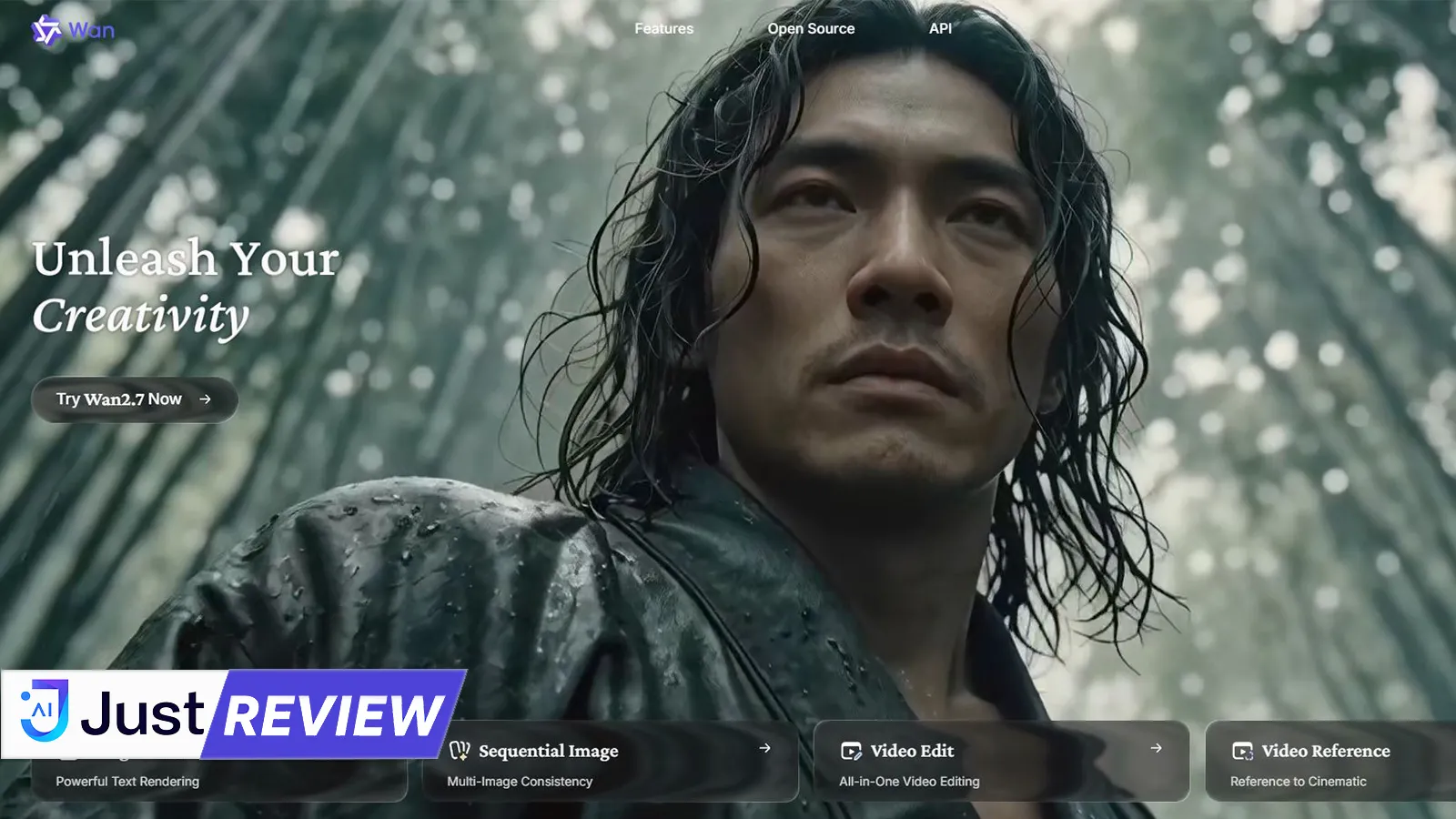
Wan is Alibaba's answer to the AI video race, and its strategy is the opposite of everyone else's mystique: give the models away, price the rest like a commodity, and let volume do the talking. Built by Alibaba's Tongyi Lab — the research arm behind the Qwen model family — Wan (from Tongyi Wanxiang) detonated its category in early 2025 by open-sourcing its video models under Apache licensing: full weights, free for anything including commercial use, runnable on a good consumer GPU. Overnight, "AI video" stopped being something you could only rent from San Francisco and became something you could own, fine-tune, and ship — and the open-source video ecosystem that exists today, from ComfyUI pipelines to a thousand niche products, runs substantially on Wan's donated foundations. The official platform at wan.video is Alibaba's own international storefront for the newest generations: a browser studio for text-to-video, image-to-video, text-to-image, and image editing, wrapped around models the community can't yet download.
One housekeeping note this catalog owes readers, given how we handled a lookalike earlier in this series: wan.video is the genuine article — Alibaba's official international platform, verifiable down to its infrastructure — while the model's fame has spawned a swarm of third-party wrapper sites with confusingly similar names selling the same models at marked-up subscriptions. If you're paying for Wan, pay Alibaba or an established API provider, not a domain that merely rhymes.
Why does a trillion-dollar commerce giant give away frontier-adjacent models? The strategy is legible and worth understanding, because it predicts how the platform will treat you. Alibaba runs the same play with Wan that it runs with its Qwen language models — now the most-adopted open model family in the world: open-source aggressively to set standards, win developer loyalty, and commoditize rivals' moats, then monetize the surrounding surface — the cloud that serves the models (every API call through DashScope is Alibaba Cloud revenue), the hosted platform with its newest closed generations, and the enterprise relationships that follow. Domestically it's also an arms race: ByteDance's Seedance and Kuaishou's Kling iterate against Wan weekly in the world's most competitive video-AI market, and that pressure — three giants leapfrogging quarterly — is precisely why this tier of models improves faster than Western release cadences. For buyers the implications are concrete: prices here trend down, not up, because cheap is the strategy rather than a promotion; the newest generation will always sit behind the hosted paywall for a while before any open release; and betting on Wan means betting on an ecosystem Alibaba has structural reasons to keep feeding — the most credible such commitment in the category, and still a commitment, not a contract.
The model line moves fast and the naming matters. The open-sourced 2.1 and 2.2 generations remain the self-hosting workhorses — genuinely capable, especially the larger variants, and free forever. The newer generations available through the platform and APIs pushed into frontier territory: native synchronized audio (dialogue, effects, ambience generated with the picture — a capability the open models lack), 1080p output, multi-shot storytelling with continuity, first-and-last-frame control for dictating exactly where a clip starts and ends, and in-video text rendering in both English and Chinese that most Western rivals still fumble. The current flagship generation has drawn "strongest model of the year" chatter from parts of the community — hype worth discounting, but grounded in a real pattern: on independent comparisons, top Wan models now trade blows with the category's leaders while remaining, by a wide margin, the cheapest serious video generation on Earth. Through APIs, Wan generates at roughly seven to twelve cents per second — an order of magnitude under Western flagship rates — which is why it has quietly become the default engine inside countless budget video products whose users have never heard its name.
Calibrating expectations honestly: Wan's ceiling is high, but the polish crown still belongs elsewhere. Veo's cinematic coherence, Sora-class physics simulation, and Kling's motion realism edge out Wan at the top of the quality range, and Wan's output benefits more than theirs from post-processing hands. The trade Wan offers is different — 80–95% of frontier quality at 5–15% of frontier price, plus the only genuine ownership story in the category. And the familiar considerations for Chinese platforms apply in the proportions we've used throughout this catalog: the hosted platform runs on Alibaba infrastructure under Chinese jurisdiction, moderation reflects that environment, and documentation still occasionally assumes Mandarin — while the open weights, as with DeepSeek, offer the exit no Western frontier lab provides: run it yourself and the jurisdiction question dissolves.
Pricing & Plans
Wan's pricing splits across three surfaces — the official platform's cheap memberships, pay-per-second APIs, and free self-hosted weights — with the structural note that free-tier output is lower-resolution, queued, and not commercially licensed, so the modest paid tiers are the real floor for published work.
| Plan | Cena | Co zawiera |
|---|---|---|
| Free (wan.video) | $0 | Daily credit allowance for trying the current models at 720p with slower queues and no commercial license — a genuine ongoing sandbox for evaluation and personal play |
| Pro membership | ~$5/mo billed yearly (~300 credits/mo) | 1080p output, priority queues, commercial use rights — plausibly the cheapest commercial license in AI video, suited to light regular output |
| Premium membership | ~$20/mo billed yearly (~1,200 credits/mo) | The volume tier for regular creators: same rights and priority with roughly 4x the allowance; credit packs purchasable on top |
| API (DashScope / third parties) | ~$0.07–0.12 per second of video | Pay-as-you-go generation at the lowest per-second rates among major models — the budget backbone for products and pipelines, with newer-generation variants at modest premiums |
| Self-hosted (open weights) | Free + your compute | The Apache-licensed 2.1/2.2 generations from Hugging Face: full ownership, fine-tuning, and offline use on a ~24 GB-VRAM GPU or rented cloud — the option that makes Wan unique among serious video platforms |
Two buying notes: verify plan details against the official site, since regional pricing and credit mechanics shift and third-party wrappers quote inflated numbers as if official — and remember the audio capability lives in the newer hosted generations, so self-hosters should budget for adding sound separately.
Key Features & Capabilities
- Frontier-adjacent generation at commodity prices — Text-to-video and image-to-video that lands within sight of the category's leaders on quality while undercutting them by an order of magnitude on cost. The price-performance ratio, not any single output, is the product — the same play DeepSeek ran on language models, executed on video.
- Native synchronized audio — Newer generations produce dialogue, effects, and ambience in sync with the picture — lip movement matching speech included — collapsing a whole post-production step for social-length content. A genuine differentiator at this price point, where most budget rivals ship silent clips.
- The open-source foundation — Apache-licensed weights for the 2.1/2.2 generations: self-host, fine-tune on your own style or product, build commercial products, run offline. No Western frontier video lab offers this; for developers and studios allergic to vendor lock-in, it's the category's only real answer. The ecosystem it seeded is the multiplier: community LoRA fine-tunes for specific styles and subjects, ready-made ComfyUI workflow graphs, control adapters for pose and motion guidance, and quantized variants that squeeze the models onto consumer hardware — an entire craft tradition, free, that hosted-only rivals structurally cannot grow.
- Production controls — First-and-last-frame conditioning (dictate exactly where a shot begins and ends — the underrated key to stitching coherent sequences), multi-shot generation with continuity, reference-driven consistency, and instruction-based editing. Less famous than rivals' equivalents, comparably useful.
- In-video text rendering — Legible, intentional text inside generated video in English and Chinese — titles, signage, packaging — where most competitors produce alphabet soup. A quiet superpower for ads and social formats built around words on screen.
- The full creative platform — wan.video bundles image generation and editing alongside video in one credit pool and browser studio — a lighter suite than Runway's, at a fraction of its price, adequate for the social-content workflows that dominate real demand.
- Ecosystem gravity — Wan models ship through every major API aggregator, run natively in community tools like ComfyUI, and power a long tail of third-party video products. Skills learned here transfer; assets aren't hostage to one storefront.
Verdict
Our verdict places Wan precisely where its pricing does: the value engine of AI video — the right choice whenever cost, volume, or ownership outranks the last increment of polish, and the wrong one only when that last increment is the job.
The clear yes, in three tiers of enthusiasm. Budget-conscious creators first: for social content, ads, product animations, and the high-volume short-form work that constitutes most actual demand, Wan's paid memberships are almost unreasonably cheap — a commercial license and 1080p output for the price of two coffees monthly, and the Premium tier's allowance at $20 embarrasses what the same money buys elsewhere in this catalog. Developers and product builders second: at seven-ish cents per second through APIs, Wan is the engine that makes video features economically viable in products where Western flagship rates would kill the business case — the same arithmetic that made DeepSeek the budget default in language, playing out again. And self-hosters third, most distinctively: studios, researchers, and tinkerers who want models they own, can fine-tune on proprietary style, and can run without any platform's permission have exactly one serious video option, and this is it — the open weights alone would earn Wan a place in this catalog if the hosted platform didn't exist.
The clear no: productions where top-shelf polish is the deliverable — cinematic brand films, footage cut against live-action, anything where the client is paying for the last 10% — still belong with Veo, Runway's marketplace, or Kling's flagship modes, and pretending otherwise wastes revision cycles that erase the price advantage. Also mismatched: buyers needing clean Western jurisdiction for sensitive material on hosted services (the self-hosting exit exists, but it's real work), teams requiring polished English-first documentation and support SLAs, and anyone whose workflow depends on audio while self-hosting the silent open generations. The moderation boundaries drawn in Hangzhou apply to the hosted platform as they do on Kling — test your actual use case on the free tier before subscribing around it.
The competitive map in one pass, since this tier of the market reshuffles quarterly: Kling is the closest rival in spirit — Chinese, aggressive, consumer-polished — winning on motion realism and image-to-video fidelity at prices above Wan's and below the West's; Seedance presses the same budget flank with periodic leapfrogs, making the three-way Chinese race the segment worth benchmarking as a group; Veo holds the polish-plus-audio crown inside Google's bundle economics; Runway sells the professional pipeline around whichever model wins the shot; and the Sora consumer story has faded into a cautionary tale about assuming any leader is permanent. Against all of them, Wan's position is unduplicated on exactly two axes — lowest serious cost and only true openness — and duplicated everywhere else. Buyers who need one of those two axes have their answer; buyers who don't should run a bake-off, because between Wan, Kling, and Seedance, this month's winner is an empirical question with a shelf life.
Practical playbook: evaluate on the free daily credits for a week against your real prompts — at these prices the trial costs nothing but attention. If you publish, take the ~$5 tier immediately for the commercial license rather than gambling on free-tier terms. Prototype compositions with cheap fast variants and spend the flagship credits on finals. Use first/last-frame control to plan sequences shot-by-shot instead of praying for coherence. For products, route through an established API provider with published rates, benchmark against Kling and Seedance quarterly (this tier of the market leapfrogs constantly), and keep the OpenAI-compatible abstraction thin so switching stays a config change. And if ownership is the point, budget a weekend for the self-hosting rabbit hole — the community documentation is excellent, and the capability compounds.
Weighing it: the category's best price-performance by a distance, the only true open-source story among serious video platforms, native audio and text rendering that punch above the price, and ecosystem gravity that makes the skills portable — against a polish ceiling below the crown-holders, hosted-platform jurisdiction and moderation considerations, documentation gaps, wrapper-site brand confusion, and a naming-and-versioning churn that demands buyer attention. That lands Wan solidly high with a clean identity: not the most beautiful video in the catalog, but the most video per dollar — and, for anyone who wants to own their tools rather than rent them, the only game in town. The self-test is the same one the free tier makes costless: run this week's real briefs through Wan's daily credits alongside your current tool, count the keepers, and divide by the price. For a large share of working creators, that arithmetic ends the comparison — and for the rest, it clarifies exactly what the premium elsewhere is buying, which is its own kind of value.
Similar Tools
BestTrending
4.7/5
An advanced Chinese AI video generation model known for highly realistic scenes.
4.6/5
AI video platform for generating and editing videos with advanced models.
Trending
4.6/5
Google's next-generation AI video model focused on realistic motion and storytelling.
3.9/5
A cinematic AI video tool focused on dramatic visual storytelling.
Trending
4.3/5
xAI conversational assistant focused on real-time information and social data.
New
3.4/5
All-in-one AI video platform for image-to-video, face/head swap, lip sync, voice cloning, and talking avatars.
People Also Ask
What is Wan 2.7?
Wan 2.7 is the latest AI video generation model from Alibaba's Tongyi Lab, built on a Diffusion Transformer architecture paired with Flow Matching — the same general approach used by most leading video models today. What makes it distinct is its breadth: rather than a single-purpose text-to-video box, it's positioned as a full creative pipeline covering text-to-video, image-to-video, multi-reference generation (up to five anchor images), first-and-last-frame control, a 9-grid storyboard mode, instruction-based editing, and native synchronized audio generated in the same pass as the visuals. It's open-source at its foundation, which is why you'll find it embedded in platforms like Picsart, fal.ai, Together AI, and various third-party front-ends, alongside the official wan.video site. In practice, it functions less like a niche cinematic tool and more like infrastructure for social media ai tools — the kind of model powering short-form video ads, product demos, and narrative clips generated from a single prompt or photo.
Is Wan 2.7 free?
There's a free tier, but it's limited. Wan 2.7 offers a Free/Trial plan at $0 with enough credits to test prompts and check output quality — essentially a handful of short test clips, not enough for a finished project. To get meaningful volume, you'd move to the Pro plan (~$5/month billed yearly, ~300 credits/month) or Premium (~$20/month billed yearly, ~1,200 credits/month, good for well over 200 videos depending on length and resolution). There are also pay-as-you-go credit packs ranging from $10–$100+ for occasional use, and per-second API billing through third-party providers like fal.ai and Together AI for developers. Compared to closed competitors, the official membership tiers are genuinely cheap for the volume offered — but per-video cost scales with resolution and duration, so heavier use at 1080p with audio will burn through credits faster than the sticker price suggests.
Is Wan 2.7 worth it?
For most solo creators, small agencies, and marketing teams producing short-form content on a budget, yes — Wan 2.7 is a strong value proposition in its price bracket. The combination of native audio synthesis, multi-reference identity consistency, and genuinely useful editing controls (rather than just a prettier text-to-video generator) sets it apart from typical budget tools, and testing showed motion physics, lighting, and skin tones noticeably improved over earlier Wan versions. It's a legitimate option to shortlist alongside bigger commercial names if you don't need feature-film-grade fidelity and budget matters. Where it's less worth it: teams needing enterprise-grade compliance, dedicated support SLAs, or guaranteed uptime, where larger, better-funded platforms still have the edge. It's also not the single best model for raw cinematic polish in complex multi-character scenes, where some temporal drift and continuity slips still show up, albeit less than expected from an open-source-rooted system.
Does Wan 2.7 generate audio automatically?
Yes — this is one of Wan 2.7's most notable features. Sound, including lip-synced dialogue, is generated in the same pass as the visuals rather than added afterward in a separate step. Most rival video generation tools still require pairing a separate voice or sound-effect track after the video is generated, which adds an alignment step that's often fiddly and time-consuming. In testing, this native audio synthesis was found to be a genuine differentiator, saving real time in the workflow by producing usable lip movement and ambient sound without needing a second tool in the loop. It's especially useful for talking-head-style dialogue clips and narrative content where audio-visual sync matters. That said, quality still depends on clip complexity — simpler scenes with a single speaker tend to sync more reliably than dense, multi-character sequences.
What resolutions and clip lengths does Wan 2.7 support?
Wan 2.7 supports clips running from roughly 2 to 15 seconds in length, at 720p, 1080p, and — through some third-party integrations — up to 4K, across standard vertical, square, and widescreen aspect ratios. In practice, though, 1080p is the more consistent sweet spot; some third-party front-ends market "cinematic 4K" output in ways that oversell what the base model reliably produces at scale. Resolution and duration also directly affect pricing, since a 15-second 1080p clip with audio consumes noticeably more credits than a short 720p draft. For anyone doing high-volume production, it's worth calculating actual per-video costs at your target resolution and length before committing to a monthly plan, since real-world costs can diverge quickly from the advertised sticker price once you're generating longer or higher-resolution clips regularly.
How is Wan 2.7 different from a typical text-to-video generator?
Most text-to-video tools are single-lane: you type a prompt, wait, and get a clip. Wan 2.7 is built as a broader creative pipeline instead. It handles text-to-video, image-to-video, multi-reference generation, first-and-last-frame control, a 9-grid storyboard mode, and instruction-based video editing — all from the same underlying model, rather than being a one-trick generator. The first-and-last-frame control gives steadier, more predictable transitions for sequential or narrative content, and the 9-grid image-to-video mode is a genuinely distinctive feature for storyboarders and comic-style creators that isn't executed this cleanly elsewhere. Combined with native audio and multi-image identity consistency, this breadth is what pushes Wan 2.7 beyond a basic generator and toward something closer to a full production tool — particularly well-suited to ai for social media content like product demos and short narrative clips rather than long-form cinematic film work.
Where can I actually use Wan 2.7?
This is genuinely one of the trickier parts of Wan 2.7 to navigate. Because the model is open-source at its core, it's been embedded across a wide range of platforms: the official wan.video membership/credit system, developer-facing API providers like fal.ai and Together AI, consumer apps like Picsart that run it as a default video model, and a long tail of smaller third-party sites offering simplified front-ends to the same underlying model. This wide availability keeps pricing competitive, but it also muddies the question of where to actually go. The recommendation is to start with the official wan.video plans or a reputable, established API provider rather than a random clone site, since quality, pricing clarity, and feature completeness can vary noticeably between these third-party front-ends even though they're all built on the same base model.