 Midjourney Review: Is It Still the Best AI Image Generator?
Reviewed by JustPrompt Editorial Team · Updated July 13, 2026
BestTrending
4.7/5
Our take on Midjourney in 2026: still the most visually stunning AI image generator around, but the pricing model and support experience have real rough edges.
- Consistently polished, cinematic image quality
- Strong style and character consistency tools
- Web editor now rivals Discord workflow
- Stealth Mode protects client and brand work
- Personalization learns your visual taste over time
- No free trial, only paid tiers from day one
- Confusing GPU-hour pricing instead of flat image counts
- Weak text rendering inside generated images
- Small prompt tweaks can shift whole compositions
Overview
Midjourney is the strange one — and the beautiful one. In an industry of venture-fueled labs burning billions, Midjourney is a small, self-funded, profitable company that has never taken outside investment, run by founder David Holz (previously of Leap Motion) with a team that would fit in a single meeting room, and it produces what much of the creative world still regards as the most aesthetically gifted image generator in existence. Since its 2022 debut it has iterated relentlessly — through the version that won a state-fair art prize and ignited a global argument, to the current V7-default, V8-generation era — while cultivating one of the largest creative communities online. Everything about it violates the standard playbook: no free tier, no ads, for years no proper website (just Discord), no API, no enterprise sales machine — and yet millions pay monthly, because the pictures are simply that good.
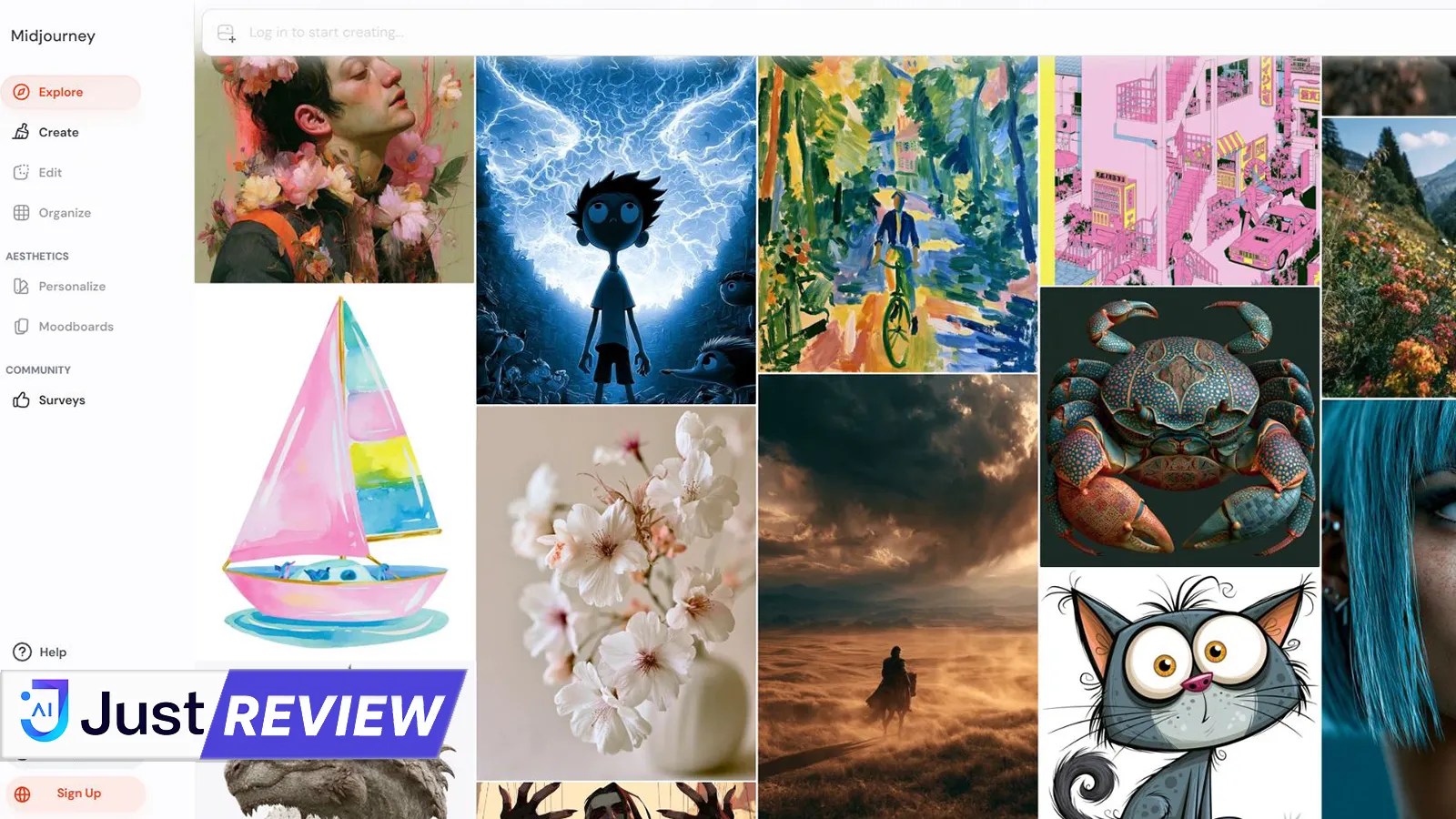
The product in 2026 is finally a normal-shaped one. The web app at midjourney.com is now the primary interface — Discord remains the cultural heart and an optional way in, but newcomers no longer need to learn a chat client to make art. The workflow: write a prompt, get a grid of images, upscale, vary, remix, edit. Around that loop Midjourney has built serious creative tooling: an editor for inpainting, outpainting, and retexturing (including on uploaded external images); Omni Reference and character/style reference systems for keeping a subject or aesthetic consistent across generations; personalization, which learns your taste from your rankings and quietly tilts outputs toward it; moodboards for building custom style profiles; draft mode for cheap rapid ideation; and an image-to-video generator that animates stills into clips of five to twenty-one seconds. The model line advances on two tracks — the mainline V series and Niji, the anime-specialized sibling — with the V8 generation sharpening prompt adherence, small-detail fidelity, and 2K output.
A word on craft, because Midjourney rewards it more than any rival. The platform grew up arcane — Discord commands, cryptic parameters, prompt incantations traded like recipes — and while the web era sanded the interface smooth, the depth remains: aspect ratios, stylization and variety dials, Raw mode for suppressing the house taste, weights and negations, chaos values, quality flags. None of it is required to get something gorgeous; all of it is what separates users who get lucky from users who get specific. The practical consequence for new subscribers is a real learning curve with a real payoff — expect your first week's results to undersell the tool, and expect the Explore feed, where every public image ships with its full prompt, to teach you faster than any tutorial. Midjourney is closer to an instrument than an appliance, and reviews that judge it on appliance terms miss why its community's loyalty borders on the devotional.
What has never changed is the thing people actually subscribe for: the look. Midjourney's default output — cinematic light, painterly texture, composed like it means it — remains the reference aesthetic of AI imagery, the standard other models get compared against. That's also the honest critique: the "Midjourney look" is recognizable enough to be a tell, and art directors who need brand-specific neutrality work against the grain of the model's taste. Meanwhile the competitive gap has narrowed from a chasm to a contest: rivals now beat Midjourney on prompt-literal accuracy, in-image text, editing workflows, and price, and several give away what Midjourney charges for. What no one has taken is the crown for images that feel authored. When the brief is "make it beautiful" rather than "make it exact," this is still the tool professionals reach for.
Two structural facts complete the picture. First, the economics: Midjourney sells GPU time, not images — every plan is a monthly block of "fast hours" the generations draw down, with unlimited-but-queued Relax mode from the Standard tier up. It's an honest system once understood and a trap for the unwary: video burns hours quickly, unused fast time doesn't roll over, and the real per-image cost depends entirely on how you work. Second, the legal weather: Midjourney trained on scraped web imagery and has never pretended otherwise, and it now faces the industry's most consequential copyright litigation — headlined by Disney and Universal's 2025 suit, with other major studios following — alongside the long-running artists' class action. Paid users own their outputs under Midjourney's terms and every tier carries commercial rights, but the platform offers nothing like Adobe's indemnification, and businesses building brand assets on it are accepting a legal context that is genuinely unresolved. Beauty, here, comes as-is.
Pricing & Plans
Midjourney sells four subscription tiers — no free plan, no trial since 2023 — where the real commodity is fast GPU time; annual billing cuts 20% off every tier, and the fine print (public galleries below Pro, non-rolling hours, video's appetite) moves real costs more than the headline prices do.
| Plan | Cena | Co zawiera |
|---|---|---|
| Basic | $10/mo (~$8/mo annually) | ~3.3 fast GPU hours (roughly 200 images), 3 concurrent jobs, full commercial rights — the cheapest way in, with no Relax mode: when hours run out, so do you |
| Standard | $30/mo (~$24/mo annually) | ~15 fast hours plus unlimited Relax-mode images (queued, 0–30 min waits) — the tier most individual creators should buy, since Relax removes the volume anxiety |
| Pro | $60/mo (~$48/mo annually) | ~30 fast hours, 12 concurrent fast jobs, and Stealth Mode — the privacy switch that keeps generations out of Midjourney's public gallery; effectively mandatory for client and brand work |
| Mega | $120/mo (~$96/mo annually) | ~60 fast hours with maximum concurrency — volume production and video-heavy workflows |
| Extras | $4/GPU hour top-ups | Additional fast hours purchasable on any plan (purchased hours persist, unlike monthly allocations); note Midjourney's terms require companies above ~$1M revenue to use Pro or Mega |
Two budgeting truths: on Basic and Standard your images are public by default — the privacy you may assume you're buying starts at $60 — and video generation consumes fast hours at a rate that makes Pro the realistic floor for anyone animating regularly.
Key Features & Capabilities
- The aesthetic engine — Midjourney's models remain the benchmark for composed, lit, textured, gallery-grade output — images that look decided rather than assembled. V8-generation improvements tightened prompt adherence and fine detail without sanding off the taste, and Niji does for anime and illustration what the mainline does for cinema.
- Personalization — Rank images and the model learns your preferences, then applies them as a persistent style bias — the closest any generator comes to being your tool rather than the tool. Combined with moodboards (custom style profiles from your own references), it's how professionals escape the house look.
- Reference systems and consistency — Omni Reference, character reference, and style reference let you hold a subject, face, or aesthetic steady across generations — answering, imperfectly but usefully, the consistency problem that separates one-off art from projects.
- The editor — Inpaint, outpaint, retexture, and reframe generated or uploaded images in a proper web editor. Midjourney arriving at "edit what exists" late but well matters: it converts the tool from slot machine toward workbench.
- Draft and Relax modes — Draft mode generates cheap, fast concepts for exploration before spending real quality on winners; Relax mode (Standard+) makes volume effectively free if you can wait minutes instead of seconds. Together they're the economics of the platform used skillfully.
- Image-to-video — Animate any generated or uploaded still into 5–21 second clips with surprisingly strong motion aesthetics. It's a finishing tool that shares your GPU budget rather than a video platform — expressive for loops, mood pieces, and social motion, not a Kling or Veo rival.
- Community and Explore — The public feed of millions of prompted images is the best prompt-education resource in AI art and a genuine creative commons — with the flip side that your own work is part of it unless you pay for Stealth.
- Deliberate absences — No self-serve public API, no official enterprise suite, no indemnification, no free tier. These aren't oversights; they're a small company choosing craft over surface area — and they define who the product can't serve.
Verdict
Our verdict starts where every honest Midjourney conversation starts: if the primary criterion is how good the images look, this is still the answer, and nothing else in the catalog quite substitutes for it.
The clear yes: artists, illustrators, and concept designers, for whom the aesthetic ceiling and the personalization system make Midjourney less a vendor than a collaborator; creative professionals producing key art, covers, posters, and moodboards where impact beats literal precision; and hobbyists serious enough to pay $10–30 for the best creative toy ever made. Tier guidance is unusually clean here: Standard at $30 is the correct plan for most people — unlimited Relax generation changes how freely you explore, and exploration is the whole game; Basic suits light or trial use with the caveat that it's publicly visible and hard-capped; Pro is not a luxury but the entry price of professional use, because Stealth Mode's privacy and the concurrency matter the moment a client's brief enters a prompt; Mega is for production volume and video habits. Annual billing's 20% is worth taking once you're sure — and the absence of any free tier means certainty costs at least one month's $10, a genuinely user-hostile gap in an industry of generous trials.
The clear no: anyone whose work needs prompt-literal accuracy, dense in-image text, or brand-neutral output as the default — the rivals built for design precision serve those briefs better, often cheaper, sometimes free; businesses that require legal cover, for whom the unresolved litigation and absent indemnification make Adobe's ecosystem the responsible choice regardless of aesthetic preference; developers, who cannot officially build on a platform with no public API; and volume-commodity users generating utilitarian imagery at scale, for whom paying premium prices for taste they don't need is simply mispurchasing. We'd also counsel awareness rather than avoidance on two fronts: the ethics of the training data, which each buyer weighs by their own lights but shouldn't weigh ignorantly — this tool's beauty has plaintiffs; and the public-by-default gallery below Pro, which has surprised more professionals than any feature in the product's history.
The competitive map, plainly: OpenAI's image models win on instruction-following and in-image text — the design-brief workhorses; Google's latest image line has become the photorealism-and-editing favorite, with identity preservation Midjourney's references only approximate; Adobe Firefly owns legal safety and Creative Cloud plumbing; Leonardo owns production workflows — training, consistency, game assets — at friendlier prices; and the open FLUX ecosystem offers frontier quality with zero subscription for the technically willing. Several of those give away meaningful free tiers, which reframes Midjourney's $10 floor. What none of them has taken — and reviewers keep re-testing precisely because the claim sounds like fandom — is the top of the aesthetic range: the frequency with which an unremarkable prompt returns an image with genuine artistic authority. If your work lives on that quality, the competition is thinner than the market map suggests; if it doesn't, the market map is full of better deals.
The strategic read: Midjourney's independence is both its charm and its question mark. No investors means no one forcing enshittification — the product has stayed ad-free, focused, and priced like it respects itself — and a profitable small company can, in principle, do this forever. It also means litigation risk lands on a company without a war chest of Google's scale, a lawsuit-loss scenario buyers with long-term dependencies should at least imagine. Our practical synthesis: creators should use it and would be poorer without it; businesses should use it with Stealth on and a plan B filed; and everyone should learn the GPU-hour system before judging the price, because the difference between "expensive" and "fair" here is entirely workflow literacy — draft cheap, relax often, spend fast hours like the currency they are.
A first-month playbook for new subscribers: start on Standard, not Basic — Relax mode's freedom to iterate is where the tool clicks, and $30 of understanding beats $10 of frustration. Spend the first sessions in Explore reverse-engineering images you admire; the prompts are all public. Learn three parameters early — aspect ratio, stylize, and Raw — and you control most of what matters. Rank images to seed personalization from day one, since its value compounds. Use draft mode for every exploration and save fast hours for upscales and finals. And before any client work, either upgrade to Pro or make peace with your process being publicly visible — deciding that after the work is in the gallery is the platform's most common regret.
Weighing it: the category's defining aesthetic, genuinely deep craft tooling, a fair-once-understood pricing model, fierce independence, and the best creative community in AI — against the missing free tier, privacy paywalled at $60, no API or enterprise story, a recognizable house look, and the heaviest legal clouds in the industry parked directly overhead. That lands Midjourney a high rating with sharp edges: the artist's choice, confidently — and a tool whose beauty, like most beauty, asks you to accept its complications.
Similar Tools
Trending
4.3/5
Generative AI platform for creating and editing images, video, audio, and vectors from text prompts.
Trending
4.3/5
A next-generation AI image model focused on realism and prompt accuracy.
BestTrending
4.8/5
AI image tool focused on design, game assets and creative visuals.
4.1/5
An open-source AI image model used by many platforms and custom workflows.
BestTrending
4.7/5
Google's multimodal AI assistant designed for productivity, research and creative tasks.
 Shopify Sidekick
4.4/5
Shopify's built-in AI system designed to help merchants generate product descriptions and automate store tasks.
People Also Ask
What is Midjourney?
Midjourney is a subscription-only AI image and video generator built by an independent, self-funded research lab rather than a big tech company. You type a natural-language prompt and it returns a grid of images you can upscale, vary, or edit further. It's best known for a distinctive, painterly, art-directed aesthetic — strong lighting, texture, and composition — that requires relatively little prompting effort to achieve compared to many competitors. What started as a purely Discord-based bot has now grown into a full web app with layers, region-based editing, style and character reference tools, and a personalization system that learns your visual taste over time. It also offers an emerging video generation feature that animates still images into short clips, plus a separate Niji model tuned for anime and illustration styles. In short, it's a tool built for creatives who prioritize finished-looking, gallery-worthy output over strict technical precision.
Is Midjourney free?
No — Midjourney has no free tier and no free trial. You must pay at least $10 for the Basic plan before generating a single image, which is a notable departure from its early open-beta days. Rather than buying a fixed image count, you're purchasing blocks of "Fast" GPU processing time, a system that regularly confuses first-time subscribers. Plans range from Basic ($10/mo) up through Standard ($30/mo), Pro ($60/mo), and Mega ($120/mo), each with more Fast GPU hours and added features like unlimited Relax Mode or Stealth Mode for private generations. Annual billing offers the only real discount, with no seasonal promos or referral credits available. If you're testing the waters, it's worth starting with a month-to-month Basic or Standard plan rather than committing annually, since Midjourney's refund policy is strict and doesn't offer much flexibility once you've used meaningful GPU time.
Is Midjourney worth it?
For most serious users, yes — Midjourney remains the tool to beat on pure aesthetic quality, and that reputation is well earned in testing. Its style and character consistency tools have matured into genuinely production-ready features rather than novelties, and the web editor removes much of the old dependency on Discord. That said, worth depends on your priorities: the GPU-hour pricing model is confusing by design, there's no free trial, refunds are hard to get, and structured or highly literal prompts can take more iteration than you'd expect from such a polished tool. We'd skip the Basic plan, since its 3.3 fast hours evaporate quickly — Standard is the plan that actually makes sense for regular use thanks to unlimited Relax Mode. If you need an API, predictable support, or enterprise copyright indemnification, it's less clearly worth it, but for freelancers, agencies, and marketers chasing best-in-class visual output, it's hard to beat.
What are the best Midjourney alternatives?
The right alternative depends on what's frustrating you about Midjourney. If you need programmatic access via an API — something Midjourney doesn't officially offer — look at tools built around open-weight models or providers with dedicated developer APIs, since Midjourney users currently have to rely on unofficial, ToS-risky wrappers. If enterprise copyright indemnification or predictable customer support matters more than raw aesthetics, open-weight or enterprise-backed generators are generally a safer bet. If your main complaint is the lack of a free trial or the confusing GPU-hour billing, tools with transparent per-image pricing or genuine free tiers may suit casual users better. That said, none of these alternatives fully replicate Midjourney's specific painterly, art-directed default look, which is why creative professionals keep paying for it despite the friction elsewhere in the product.
Does Midjourney have an API?
No, Midjourney does not offer an official API. This is one of its most consistent limitations compared to other AI image generators, and it's a real problem if you're trying to build Midjourney generation into an automated pipeline, app, or AI automation tools workflow. Anyone needing programmatic access currently has to rely on unofficial third-party wrappers that scrape or interface with the Discord bot or web app indirectly — an approach that carries genuine terms-of-service risk and could break without warning if Midjourney cracks down on it. This makes Midjourney a poor fit for developers or businesses that need reliable, sanctioned programmatic integration, and it's a major reason enterprise teams evaluating automated content pipelines often look toward alternatives with official, supported APIs instead, even if the visual output quality doesn't quite match Midjourney's.
Does Midjourney render text well in images?
Not reliably. Text rendering inside Midjourney images is still inconsistent, and this is one of the most frequently echoed complaints across independent reviews and community discussion. While the model excels at lighting, texture, and overall composition, asking it to accurately render specific words, logos, or labels within an image often requires significant trial and error, and results can still come out garbled or approximate rather than crisp and legible. If your use case depends heavily on accurate in-image text — packaging mockups, posters with specific copy, or infographics — you should expect to do manual touch-ups afterward, either in Midjourney's own web editor or a dedicated design tool. This is a known gap across most AI image generators, but it's worth flagging clearly since it can catch new users off guard given how polished the rest of Midjourney's output looks.
What is Stealth Mode and who needs it on Midjourney?
Stealth Mode keeps your generations private and out of Midjourney's public community gallery, and it's available starting on the Pro plan ($60/mo) and above. By default, Midjourney generations are visible to anyone browsing the public gallery, which is a problem if you're an agency or freelancer working on unannounced client projects, unreleased products, or anything under NDA. Without Stealth Mode, your work-in-progress concepts could be publicly discoverable before a client launch. If privacy isn't a concern — say you're a hobbyist building a personal portfolio — you likely don't need to pay the premium for Pro just for this feature, and Standard's unlimited Relax Mode will serve you better dollar for dollar. But for any commercial or client-facing creative work, Stealth Mode is effectively a must-have rather than a nice-to-have.