 ElevenLabs Review: Best AI Voices, Trickiest Pricing
Reviewed by JustPrompt Editorial Team · Updated July 13, 2026
BestTrending
4.9/5
We tested ElevenLabs' TTS, voice cloning, dubbing, and agent platform to see who justifies the credit costs — and when cheap commodity TTS wins instead.
- Best-in-class voice realism and emotional expressiveness
- Fast, high-quality instant voice cloning from short samples
- Deep feature set: dubbing, sound effects, agents, STT, music
- Supports 70+ languages with strong accent handling
- Mature API with SDKs for real production integration
- Credit system burns through fast, especially on retries
- Free tier is barely usable and blocks commercial use entirely
- Occasional generation failures, timeouts, and login/auth issues
- Pricing structure is genuinely confusing across UI vs API tiers
Overview
ElevenLabs is the company that made AI voices stop sounding like AI — and in doing so, became the default answer to a question thousands of products now ask: "who does our audio?" Founded in 2022 by two Polish school friends — Piotr Dąbkowski, a former Google machine-learning engineer, and Mati Staniszewski, ex-Palantir — the company traces its origin story to the famously flat voiceovers of Polish film dubbing, and the conviction that machines could do expressive speech better. Four years later, that hunch has grown into one of Europe's most valuable AI startups, with a valuation measured in billions and technology embedded across publishing, gaming, film localization, audiobooks, education, and an accelerating wave of voice-driven AI agents.
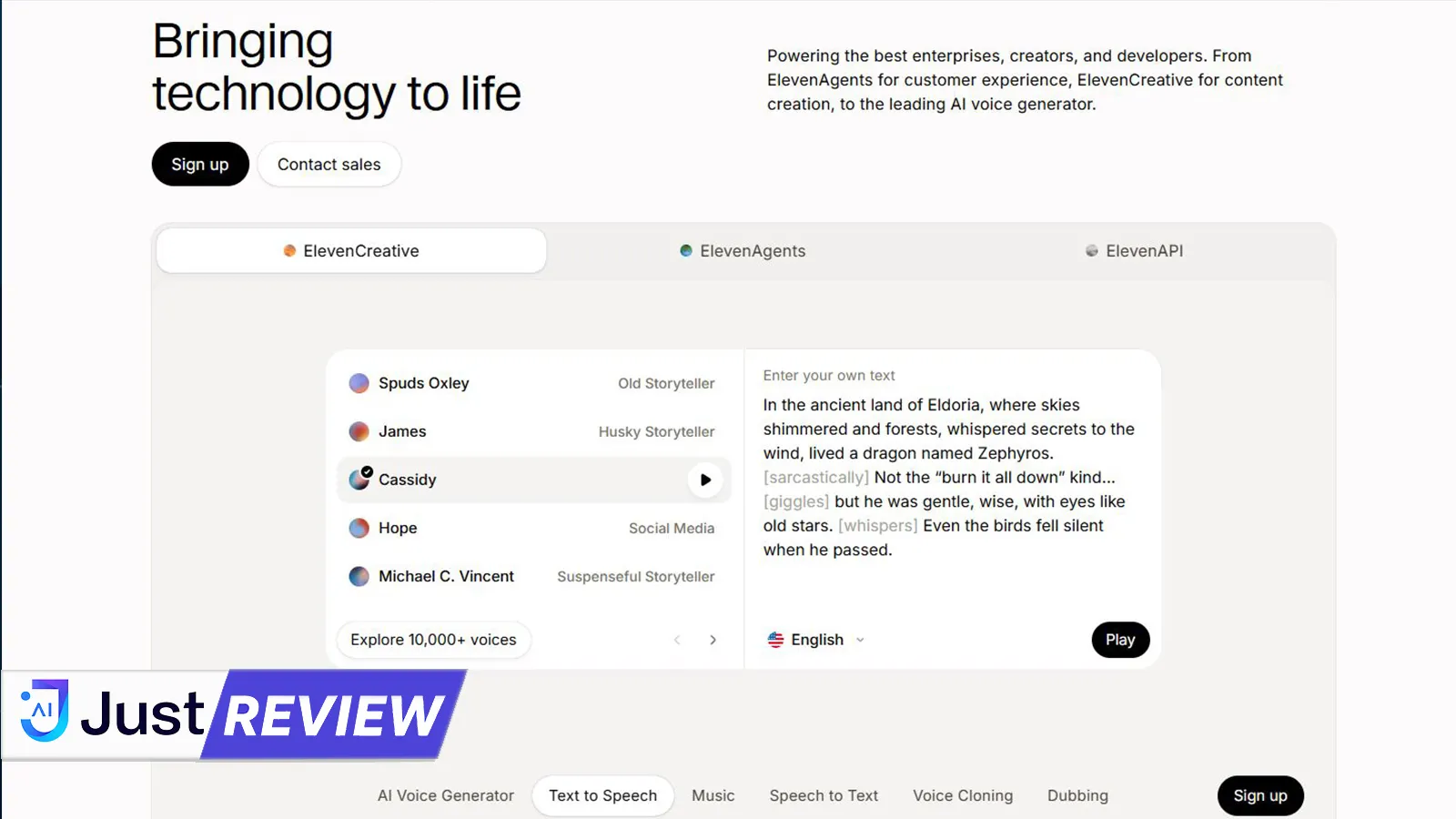
The core product is text-to-speech that leads the industry on the metric that matters: believability. ElevenLabs voices breathe, hesitate, shift emotional register mid-sentence, and handle over 70 languages and accents with a naturalness that competitors chase but rarely match — a lead the community consensus has held remarkably stable even as Big Tech and startups alike have poured resources into catching up. The current model family spans a flagship expressive tier — where newer models accept inline audio tags directing delivery ("whispers," "sighs," "excited") — and fast, low-latency models built for real-time applications, where response speed matters more than the last percent of warmth.
Around that core, ElevenLabs has assembled a full audio-AI suite. Voice cloning comes in two grades: instant cloning from a minute of audio, and Professional Voice Cloning trained on longer samples, which produces replicas that routinely fool the people being cloned. A voice marketplace lets voice owners license their clones and earn royalties when others use them — one of the more genuinely constructive answers the industry has produced to the "AI is stealing voice work" problem, even if it hasn't ended that argument. A dubbing studio translates videos while preserving the original speakers' voices across dozens of languages. Scribe, the speech-to-text model, turned heads by beating specialist incumbents on accuracy benchmarks. There's a sound-effects generator, a voice isolator, music generation trained on licensed catalogs through deals with major music-rights bodies, a consumer Reader app that narrates anything you feed it, and — the clearest signal of where the company is heading — a Conversational AI platform for building real-time voice agents: the plumbing (speech recognition, turn-taking, interruption handling, tool calls, telephony) that lets businesses stand up a natural-sounding phone or in-app agent without assembling five vendors.
Distribution tells you what kind of company this really is. Beyond the studio interface, ElevenLabs runs a developer API with streaming and websocket support fast enough for live conversation, SDKs across major languages, and integrations that have made it the default audio layer inside countless third-party apps — video editors, game engines, agent frameworks, and no small number of the AI products reviewed elsewhere in this catalog quietly pipe their audio through it. That embedded position is the moat, because the pure model lead is genuinely contested now: OpenAI and Google ship capable, cheaper TTS; specialized startups compete hard on latency for agent use cases; and open-source voice models have gone from toys to credible for undemanding work. ElevenLabs' answer has been to race upmarket and outward — more expressiveness, more languages, more of the surrounding workflow (dubbing, transcription, agents, music) bundled into one platform and one credit pool — betting that owning the whole audio pipeline beats winning any single benchmark. So far, the market share suggests the bet is working.
Every honest account of ElevenLabs also has to hold the darker thread. Technology this good at imitating humans is inherently dual-use, and ElevenLabs has been at the center of the deepfake era's defining incidents — most infamously when a fake President Biden robocall built with its tools targeted New Hampshire primary voters in 2024. Scams impersonating relatives, fraud targeting voice-authentication systems, and non-consensual celebrity voices have all traced back, at various points, to this class of technology. The company has responded with escalating safeguards: identity verification for professional cloning, no-go lists for high-risk voices, provenance tooling that can identify its own audio, and moderation that has visibly tightened over time. Reasonable people differ on whether that's enough; what's not debatable is that the risk is intrinsic to the product category ElevenLabs leads, and prospective users — especially businesses — should understand both the safeguards and the reputational context they're buying into.
The practical experience of using it is simpler than all that: paste text, pick a voice, generate, adjust, regenerate. Which brings up the tax everyone eventually meets — credits. Everything on the platform draws from one monthly credit pool, roughly one credit per character of standard speech, and the iterative reality of creative work (regenerating a line five times to get the read right) means real projects consume credits faster than the tidy minutes-per-plan math suggests. Understanding that system is most of understanding the pricing, so let's go there.
Pricing & Plans
ElevenLabs prices by monthly credit allowances shared across all tools, with annual billing saving roughly 17% — and one rule that matters more than any number: the free tier carries no commercial rights, so anything published or monetized requires a paid plan.
| Plan | Cena | Co zawiera |
|---|---|---|
| Free | $0 | ~10,000 credits (~10 minutes of standard TTS), stock voice library, most tools in demo form; attribution required, no commercial use, no voice cloning |
| Starter | $6/mo | ~30,000 credits (~30 minutes), the all-important commercial license, instant voice cloning, and dubbing access — the minimum viable tier for anything public |
| Creator | $22/mo (frequent ~50% first-month promos) | ~121,000 credits (~2 hours), Professional Voice Cloning, higher-quality audio output, usage-based overage billing — the sweet spot for YouTubers, podcasters, and indie audiobook work |
| Pro | $99/mo | ~500,000–600,000 credits (~10 hours), 44.1 kHz audio via API, higher concurrency — for professional studios and serious production volume |
| Scale | ~$299/mo | ~1.8–2 million credits with a multi-seat workspace — agencies and localization teams |
| Business | ~$990/mo | ~6 million+ credits, ~10 seats, low-latency modes and priority support — high-volume production and product teams |
| Enterprise | Custom quote | Custom volumes, SLAs, advanced security and compliance, custom voices at scale, and negotiated per-unit rates for the agents platform |
Two footnotes worth their weight: prices at the team tiers were adjusted downward in early 2026 while Starter crept up, so verify the live page; and conversational-agent usage is metered per minute rather than per character, with its own economics that heavy agent builders should model separately.
Key Features & Capabilities
- State-of-the-art text-to-speech — The reference standard for natural AI speech: expressive, multilingual (70+ languages), and controllable down to pacing, stability, and emotional delivery — with newer models taking inline direction the way an actor takes stage notes. In our testing, long-form narration holds character over hours of audio, which is the hard part competitors still fumble.
- Voice cloning, instant and professional — Instant cloning produces a usable replica from about a minute of audio; Professional Voice Cloning, trained on longer samples with identity verification, produces one that's uncomfortably convincing. For narrators scaling their own output, brands with a signature voice, or accessibility uses (including preserving the voices of people losing theirs), this is the platform's most personal and most powerful feature.
- Voice Library marketplace — Thousands of licensed voices whose owners earn royalties on usage — a real revenue channel for voice talent and a legally clean casting pool for producers who need commercial-safe voices without negotiating individual contracts.
- Dubbing studio — End-to-end video translation that preserves each speaker's voice, tone, and timing across dozens of languages, with an editor for correcting the inevitable translation stumbles. Quality lands at "impressively good, still needs human review" — transformative for creators expanding internationally, not yet a replace-the-localization-team button.
- Conversational AI agents — A full stack for real-time voice agents: low-latency models, turn-taking and interruption handling, tool calling, knowledge grounding, and phone-system integration. This is the platform's strategic bet — moving from selling audio generation to powering the voice interface of software generally — and it's already the backbone of a fast-growing population of customer-service and scheduling agents.
- Scribe speech-to-text — A transcription model that arrived late and immediately benchmarked at or above the specialist leaders, with strong multilingual accuracy, speaker labels, and audio-event tagging. Bundled into the same platform and credit pool, it rounds ElevenLabs into a both-directions audio company.
- Music and sound effects — Text-to-music trained on licensed catalogs via deals with major rights bodies — a deliberate legal contrast to competitors trained on scraped audio — plus a quick sound-effects generator. The music is production-usable for background and mood; it's not threatening dedicated composers yet.
- Reader and creator apps — A consumer app that narrates articles, PDFs, and ebooks in premium voices, plus browser-based studio tools for long-form projects. Minor revenue, major funnel — and genuinely pleasant products in their own right.
Verdict
Our verdict starts from a rare position: on core quality, there's no serious dispute. If your work needs AI speech that listeners will mistake for human — audiobooks, video narration, dubbing, branded voices, voice agents customers actually tolerate — ElevenLabs is the industry standard, and the gap to cheaper alternatives is audible within the first paragraph of generated audio. The question isn't whether it's good; it's whether your use case justifies its economics and survives its fine print.
The clear yes: content creators publishing regularly should start at Creator — Professional Voice Cloning plus two hours of monthly audio covers most podcast, YouTube, and indie audiobook workflows, and the per-credit price is the best in the individual lineup. Businesses building voice features or agents should evaluate the platform seriously before assembling a cheaper multi-vendor stack; latency, voice quality, and the integrated agent plumbing are where ElevenLabs earns its premium, and the enterprise tier exists precisely for negotiating volume economics. Publishers and studios localizing content internationally may find the dubbing workflow alone worth the subscription. And accessibility use cases — voice banking, assistive reading — represent some of the most unambiguously good applications of this technology anywhere.
The clear no: anyone whose need is occasional, internal, or indifferent to expressiveness. If you're generating a monthly internal training video or need bulk utilitarian narration where "clear" beats "human," commodity TTS from the big clouds costs a fraction of ElevenLabs' rates and nobody will notice. Free-tier users planning to publish should understand the license: no commercial rights, attribution required — the $6 Starter is the real entry price for public work. Budget-sensitive high-volume users should model costs honestly, because the credit system's iterative tax is real: regenerations, experiments, and multi-tool projects drain allowances faster than the minutes-math implies, and the platform's pricing consistently rewards moving up tiers rather than staying lean. Voice actors and audio professionals, finally, have understandable and unresolved grievances with this entire category; the marketplace royalty model is a better answer than most competitors offer, but "better than most" is not the same as settled.
A few working habits stretch every tier further. Draft with the fast, half-price models and reserve the flagship voice for final renders — the single biggest credit saver available. Fix pronunciation problems at the source with phonetic spellings or the pronunciation dictionaries rather than regenerating full passages hoping the model guesses differently. Generate long scripts in paragraph-sized chunks so a flubbed line costs one chunk, not a chapter. Nail down a voice's stability and style settings on a short test passage before committing an hour of narration to them, since changing settings mid-project creates audible seams. And if you're on Creator or above, enable usage-based overage consciously rather than discovering it on an invoice — it's a feature when a deadline hits and a leak when a workflow is sloppy. Users who adopt these habits routinely produce double the finished audio per credit pool of those who brute-force regenerate, which in practice is the difference between a tier fitting and not.
Two adult-supervision notes for business adopters. First, governance: cloning requires consent workflows you should formalize, not improvise — whose voice, licensed how, revocable when — because the legal environment around voice likeness is tightening in multiple jurisdictions and retrofitting consent is expensive. Second, reputational context: you're building on the most capable voice-synthesis platform in the world during the era of voice fraud, and while ElevenLabs' safeguards are among the category's most developed, your own use policies are part of the safety story your customers will judge.
Weighing it all: category-defining quality, a genuinely complete audio suite, credible safety and licensing efforts that outpace the competition, and fair mid-tier pricing — against credit economics that punish iteration, a free tier that's a demo rather than a tool, agent pricing that needs careful modeling, and the irreducible dual-use shadow over the whole category. That earns ElevenLabs one of the stronger ratings in this catalog: the rare AI tool that is simultaneously the best at what it does and honest work to use well. If audio matters to your output, it belongs in your stack; size the tier to your real regeneration habits, not your optimistic minutes estimate. And revisit that sizing quarterly — between model releases, credit repricing, and your own growing ambitions for what AI audio can carry, the right plan this quarter is rarely the right plan a year from now.
Similar Tools
4.2/5
All-in-one audio editing tool with transcription and AI voice features.
4.2/5
Professional AI voice generator for voiceovers, presentations and videos.
4.2/5
Voice cloning and AI speech generation for apps and media production.
3.7/5
Speech-to-text API and transcription service for meetings and audio.
4.0/5
Text-to-speech tool that converts articles and documents into audio.
Trending
4.4/5
European AI models focused on efficiency, open research and developer tools.
People Also Ask
What is ElevenLabs?
ElevenLabs is an AI voice company, founded in 2022, that started as a text-to-speech generator and has grown into a full audio stack. Today the platform covers text-to-speech with emotional inflection, instant and professional voice cloning, an AI dubbing studio, a voice changer, sound effects and music generation, speech-to-text, and a conversational AI agents platform for building voice bots — all running on a shared credit system with a serious developer API. It's used by solo creators doing YouTube narration all the way up to enterprises like Twilio embedding ElevenLabs voices into call-center products. Based on our hands-on testing across the web and mobile apps, the standout strength is voice quality: pacing, tone shifts, and emotional realism that genuinely outperform older TTS engines. It's less a single tool and more a platform, which is why it's become the reference point every other AI voice company gets compared against.
Is ElevenLabs free?
Yes, but with real limits. The free plan gives you 10,000 credits per month (roughly 10 minutes of TTS), access to the standard voice library, and enough headroom to genuinely test voice quality. The catch is that free-tier output carries no commercial rights and requires ElevenLabs attribution, so you legally can't use anything you generate on a monetized YouTube channel or in client work. To unlock commercial licensing, instant voice cloning, and Dubbing Studio access, you need at minimum the Starter plan at $5–$6/month. In our testing, the free tier is best understood as a demo — it convincingly shows you why the voice quality is impressive, but it won't let you actually ship a real project. If you're serious about producing content regularly, budget for Starter or Creator ($22/month) rather than trying to make the free tier your permanent home.
Does ElevenLabs offer voice cloning?
Yes, and it's one of the platform's strongest features. ElevenLabs offers two tiers: Instant Voice Cloning, which can produce a usable clone from as little as 30 seconds to a few minutes of clean audio, generated in seconds and immediately callable via the API — great for quick creator use cases. Then there's Professional Voice Cloning (PVC), which uses longer, higher-quality samples to build a hyper-realistic 'digital twin' of a voice, aimed at podcasters, audiobook narrators, and brands that need consistent, repeated use of the same voice at scale. In our hands-on testing, both cloning tiers sounded noticeably better than competing apps we've tried, holding up well even across accents and multilingual delivery. Keep in mind that voice cloning for commercial purposes requires at least the Starter plan, since the free tier doesn't include commercial rights or cloning access at all.
Is ElevenLabs worth it?
Based on our testing, yes — with a caveat. The voice quality is genuinely the best we've heard for emotional realism, the cloning tools are fast and useful for both creators and businesses, and the platform's breadth (dubbing, agents, sound effects, a production-grade API) means it can scale from a solo side project to an enterprise voice-agent deployment without switching vendors. That's rare in this category. Where it stumbles is the credit system, which is confusing until you've burned through a plan or two, and reliability — user reviews across both app stores (a combined 170,000+ ratings, 4.8★ iOS / 4.6★ Android) consistently mention generation failures and occasional login issues even on paid plans. If you're serious about voice content — a monetized channel, client work, or a production voice agent — it's worth budgeting for at least the Creator or Pro tier and watching usage closely. For casual dabbling, it's worth trying free, just don't expect to ship anything on that tier.
Is ElevenLabs better than Murf or Play.ht?
On raw voice quality and cloning fidelity, our testing puts ElevenLabs ahead of alternatives like Murf, Play.ht, Descript, and Amazon Polly. The emotional range in ElevenLabs' Multilingual v2 and v3 models — genuine pacing, tone shifts, and inflection rather than flat cadence — is noticeably more natural than what we've heard from competing tools, and its cloning tools (both instant and professional) tend to produce a more convincing 'digital twin' of a voice. Where ElevenLabs asks you to work harder is its shared credit system, which spans TTS, dubbing, agents, and sound effects simultaneously and can feel confusing compared to simpler per-minute or flat-rate pricing from some competitors. So the trade-off is real: you're paying a bit more and dealing with a less intuitive pricing model in exchange for what we consider the best-sounding, most expressive voice output currently available, plus a much broader platform if you need dubbing or conversational agents alongside TTS.
What are the best ElevenLabs alternatives?
The most commonly cited alternatives to ElevenLabs are Murf, Play.ht, Descript, and Amazon Polly, each with a different focus. Murf and Play.ht lean toward straightforward, budget-friendly text-to-speech with simpler pricing structures, which can appeal to users put off by ElevenLabs' shared credit system. Descript is more of a full editing suite with TTS and voice cloning bundled into a broader audio/video editing workflow, useful if you want editing and voice generation in one place. Amazon Polly is the enterprise/developer-first option, tightly integrated into AWS infrastructure for teams already building on that stack. In our assessment, none of these fully match ElevenLabs on emotional realism or cloning fidelity — that's still ElevenLabs' clearest advantage. But if pricing simplicity, an editing-first workflow, or AWS integration matters more to your use case than best-in-class voice quality, one of these alternatives may be a better practical fit.
Does ElevenLabs support video dubbing and translation?
Yes — this is handled through ElevenLabs' Dubbing Studio, one of the more distinctive features on the platform. It automatically translates and re-narrates video or audio content into dozens of languages while preserving the original speaker's voice characteristics, and it syncs reasonably well to lip movement. You can pull content directly from YouTube, TikTok, or X links rather than needing to manually upload and re-edit files, which streamlines the workflow considerably for creators localizing existing content. Dubbing Studio access requires at least the Starter plan ($5–$6/month), since it's not included in the free tier. In our hands-on testing, this was one of the more impressive parts of the broader 'audio stack' ElevenLabs has built out beyond basic text-to-speech, and it's a meaningful differentiator from more narrowly-scoped competitors like Murf or Play.ht, which don't offer comparable dubbing capabilities.